

CFD Analysis of Vertical Pump Sump
April 8, 2023
CFD Analysis of Heat Exchanger
April 8, 2023
Introduction
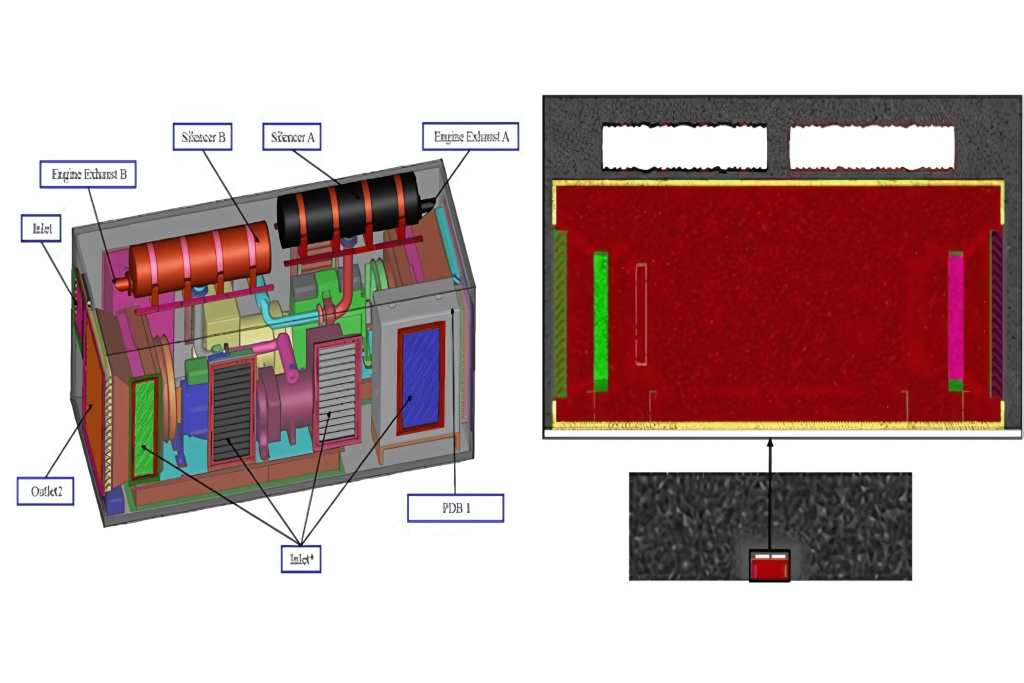
A canopy is a unit containing various components like a cooler, fan, compressor, engine, motors, fuel tanks, electrical compartment, etc. Cooler fans should be able to supply sufficient air flow to the various units of canopy and maintain the temperature below critical temperature. Multiple coolers with heat load applied on it, Engine heat load, Exhaust system heat load and radiation heat load on Canopy walls make the canopy system very complex to study. CFD helps in understanding the amount of flow rate going to various components, flow pattern inside the canopy, identification of flow short circuiting, locating recirculation & dead regions and thermal distribution inside the canopy. Such problems may lead to lower efficiency of the components inside the canopy.
Challenges
- Modelling of heat dissipation within various units due to forced convection.
- Modelling of combined convection, conduction, & radiation at the canopy outer surface.
- Canopy involves lot of components and meshing them needs to be strategized.

SOLUTION
Transient flow and thermal simulation of the canopy was carried out when single engine operating for 24 hours & double engines operating for 1/2-hour scenarios. Consideration of radiation load over canopy surfaces along with the conduction & convection within canopy made the thermal system very complex for obtaining the heat balance. Transient variation in skin temperature of various components was studied. Also, the flow short circuiting paths, recirculation dead regions, temperature distribution inside canopy and temperature profile on engine, cooler, intake & exhaust systems are observed. In both scenarios, the Cooler fan flow rates are compared with minimum flow requirement criteria. Also, the skin temperature of various components of Canopy is checked and compared with critical limits.
BENEFITS
- Prediction of Cooler fan flow rates under the overall resistance of complete Canopy system.
- Virtual testing of Canopy under single & double engine operating scenarios.
- Predicted appropriate design modifications as per CFD results & thermal requirement.
- Reduced number of trials for hassle free operation of Canopy under various scenarios