

CFD Analysis of HRSG Unit
April 8, 2023
CFD Analysis of Fin Mounted on Hull
April 8, 2023
Introduction
Cyclone separators are used extensively to classify
mineral slurries with a size or density distribution in the mineral and coal industries. In Cyclone it is very important to accurately determine the back pressure (pressure drop) and particle separation efficiency across Cyclone. CFD helps in determining these parameters by closely simulating continuous phase (ex. flue gas) and discrete phase (ex. ash particles) flow within the Cyclone. Cyclone analysis becomes more complex due to presence of tube bundle on upstream side of Cyclone entry and in presence of these tube bundles it is very important to predict accurate velocity profile at Cyclone entry which can be achieved in CFD.
Challenges
- Proper consideration of particle size distribution data into CFD.
- Multiphase modelling (DPM approach) to consider effect of particles.
- Proper selection of restitution coefficient for accurate modelling of particle trajectory.
SOLUTION
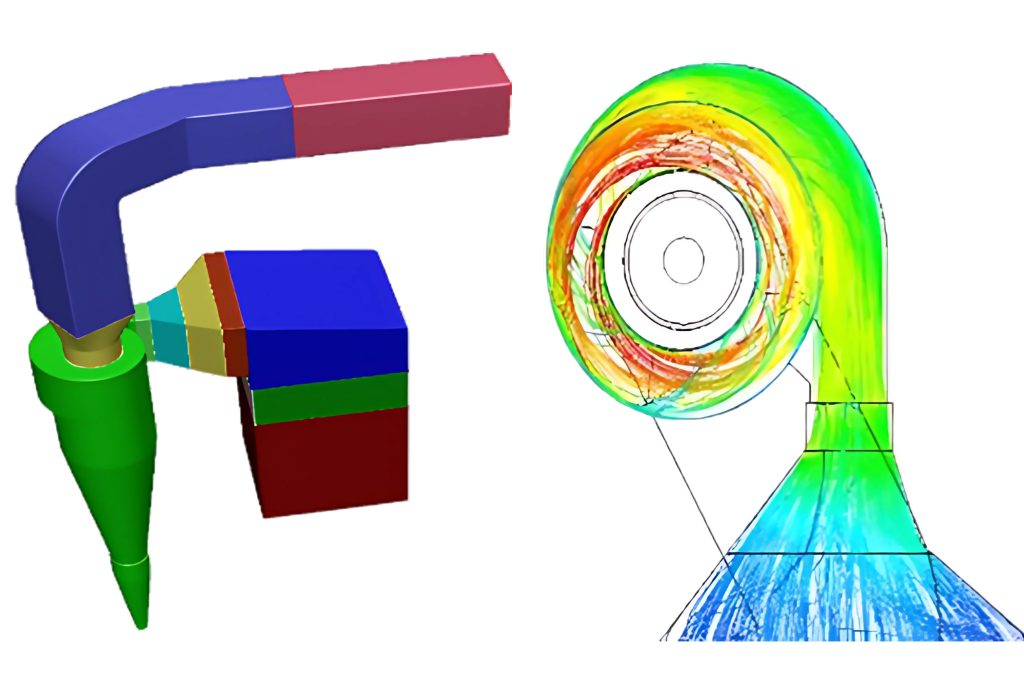
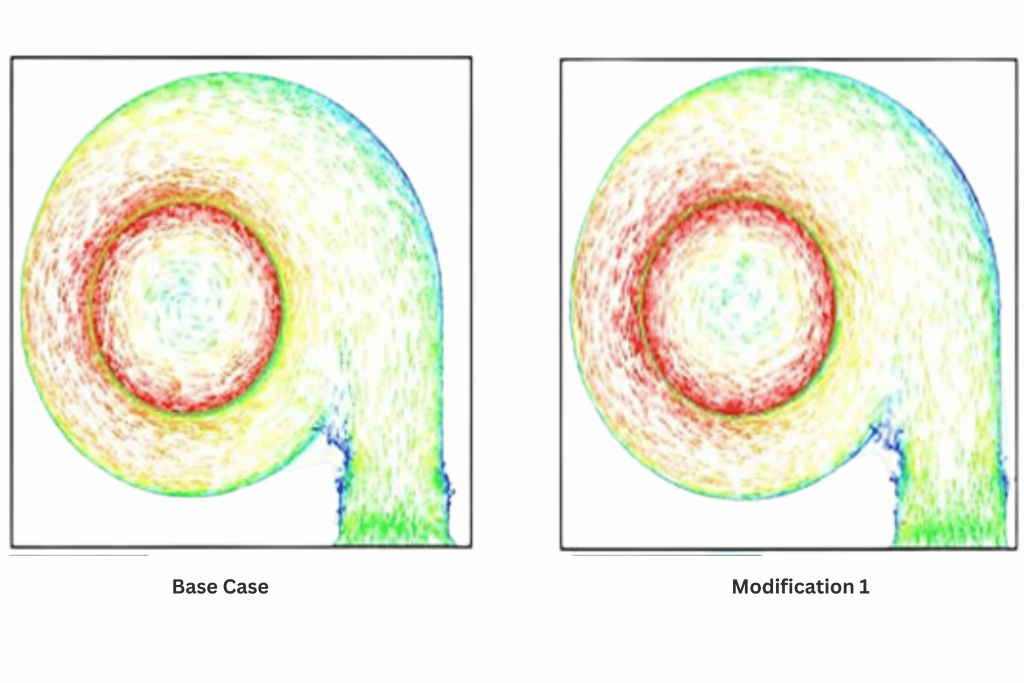
CFD analysis of the cyclone separator was carried for determining pressure drop, particle trajectory and particle separation efficiency of Cyclone. Initially continuous phase simulation was carried out for determining pressure drop across Cyclone by properly considering the direction resistance of tube bundles. Available particle size data was used in appropriate way to define particle size distribution in CFD. Appropriate values of restitution coefficient were selected for accurate modelling of particle trajectory. Particle trajectory observed for various sizes of particles. Based on initial results, design modifications were carried out in Cyclone upstream side converging duct and within Cyclone duct for rend particle separation efficiency were during the pressure drop across cyclone, improving the particle separation efficiency. This modification has also helped in reducing the erosion rate of Cyclone duct wall which was happening due to concentration of large dimeter particles at one particular region of Cyclone duct wall.
BENEFITS
- Appropriate design modification in Cyclone for reducing pressure drop across Cyclone.
- Accurate prediction of particle trajectory and particle separation efficiency.
- Reduced number of trials for optimum design.