
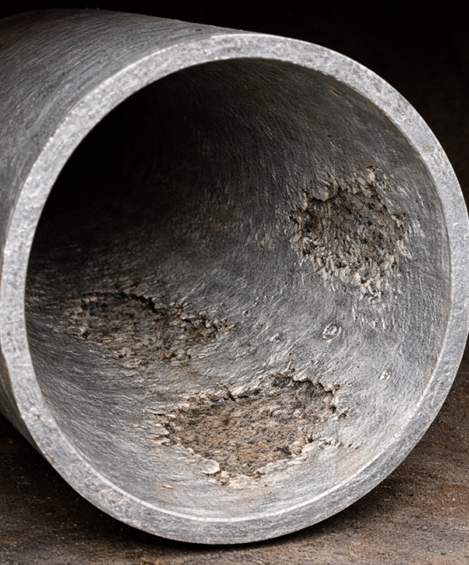
Fitness-For-Service Assessment of Local Thin Areas (LTA) in a Cylindrical Pressure Vessel Shell
January 19, 2026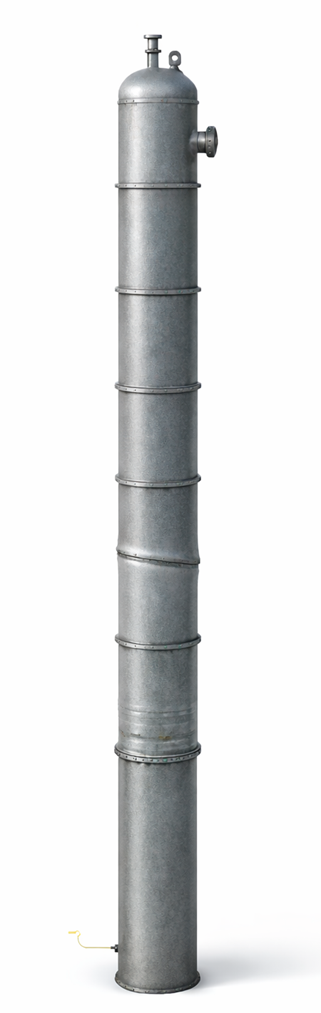
Fitness-For-Service Assessment of Weld Misalignment & Shell Distortion
January 30, 2026Background
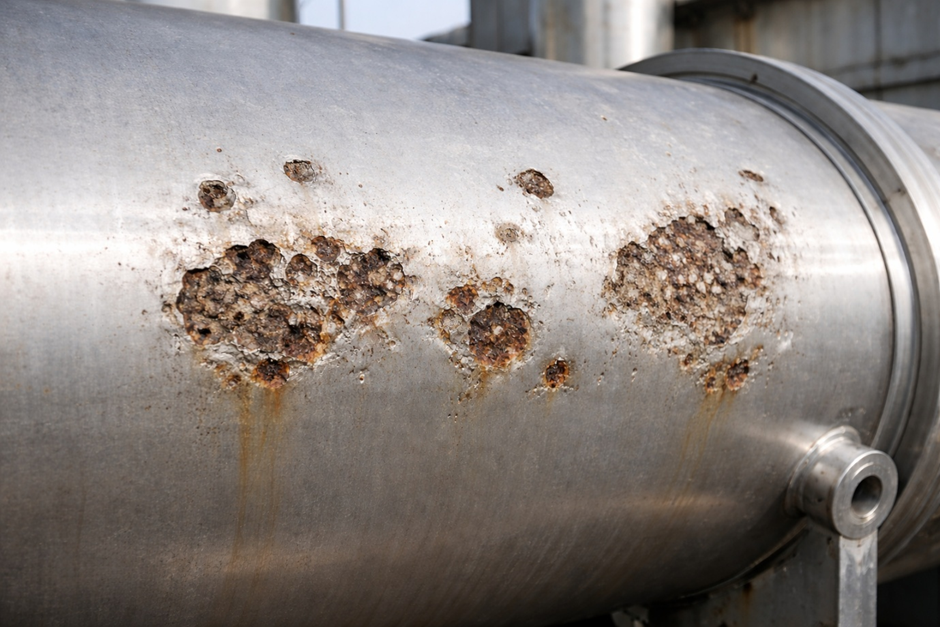
Localized metal loss in the form of pitting corrosion is a common degradation mechanism in carbon steel pressure vessels operating in corrosive service environments. Unlike general metal loss, pitting corrosion involves highly concentrated material removal over small surface areas. These pits can create localized stress intensification and potential leak paths if they are not properly assessed.
This case study presents a Fitness-For-Service (FFS) assessment of a cylindrical pressure vessel shell exhibiting widespread pitting corrosion on the external surface. The objective of the assessment was to determine whether the vessel could safely continue operation at its current Maximum Allowable Working Pressure (MAWP) and operating temperature using a structured FFS methodology.
Vessel and Operating Scenario
The pressure vessel was assumed to be designed and fabricated in accordance with ASME Section VIII, Division 1 for internal pressure service. The shell material consisted of a carbon steel grade commonly used in pressure vessel construction. The equipment had been in service for several years under steady operating conditions.
During routine inspection, inspectors identified extensive pitting corrosion on the outer diameter surface of the cylindrical shell. The inspection classified the corrosion as arrested, with no evidence of active pit growth at the time of examination. Uniform corrosion was present on the opposite surface; however, no interaction between the two damage mechanisms was observed.
The vessel operated under internal pressure only. It was not subjected to cyclic loading or supplemental external loads. A future corrosion allowance was defined to account for potential degradation during continued service.
Inspection Data and Damage Characterization
Inspectors performed visual examination, surface profiling, and pit depth measurements in the region exhibiting the highest pit density. The inspection focused on identifying the deepest pit and characterizing the overall distribution of pitting damage.
Key observations from the inspection included:
• Multiple shallow pits distributed over a localized region
• No evidence of pit coalescence or crack initiation
• Maximum pit depth occurring at a single isolated location
• Pit diameters remaining below the threshold associated with Local Thin Area (LTA) behaviour
Based on these observations, engineers classified the damage mechanism as pitting corrosion acting on a single surface, making it suitable for evaluation using API 579 pitting assessment procedures.
Assessment Philosophy
The Fitness-For-Service evaluation followed API 579 / ASME FFS-1 Part 6, using a structured Level 1 assessment approach.
The assessment objectives were to:
• Verify compliance with minimum remaining thickness requirements
• Prevent localized failure modes such as pinhole leakage
• Evaluate acceptability at the current MAWP
• Determine whether a higher-level assessment was required
This philosophy emphasizes conservative screening while avoiding unnecessary repair or replacement.
Level 1 Assessment
The Level 1 pitting assessment evaluated the remaining ligament thickness beneath the deepest pit. The calculation accounted for uniform metal loss and the defined future corrosion allowance.
The assessment demonstrated that:
• The minimum remaining thickness beneath the deepest pit exceeded the allowable limit
• The remaining wall thickness ratio satisfied Level 1 acceptance criteria
• The pitting damage did not compromise pressure containment
Based on pit dimensions and spacing, the damage did not qualify as a Local Thin Area. Therefore, escalation to a Level 2 local metal loss assessment was not required.
Allowable Pressure Evaluation
Engineers recalculated the Maximum Allowable Working Pressure using the remaining effective wall thickness, allowable stress at operating temperature, and applicable weld joint efficiency.
The recalculated MAWP exceeded the vessel’s current operating pressure. This result confirmed that the vessel retained sufficient pressure integrity despite the presence of pitting corrosion.
Remaining Life Considerations
• Although inspectors classified the pitting corrosion as arrested, the presence of uniform metal loss on the opposite surface warranted consideration of future degradation.
• Based on the defined corrosion allowances and inspection findings, continued monitoring was recommended. Periodic inspection will ensure that both pit depth and general corrosion remain within acceptable limits throughout the remaining service life.
Engineering Conclusion
• The Fitness-For-Service assessment confirmed that the pressure vessel is acceptable for continued operation at its current MAWP and operating temperature under Level 1 pitting corrosion criteria.
• This case demonstrates that pitting corrosion, when properly characterized and evaluated using API 579 methodologies, does not automatically require repair or pressure de-rating. Continued operation remains acceptable provided minimum ligament thickness and pressure integrity requirements are satisfied.