
Fitness-For-Service Assessment of Local Metal Loss (Pitting Corrosion) in a Pressure Vessel Shell
January 21, 2026Background
Pressure vessels subjected to improper or non-uniform post-weld heat treatment (PWHT) may experience permanent geometric distortions. These distortions commonly manifest as weld misalignment, ovality, or general shell deformation, particularly in tall, ring-stiffened cylindrical sections.
Such geometric imperfections can introduce secondary stresses, reduce structural stability, and raise concerns regarding plastic collapse or buckling under combined pressure and environmental loading. These issues are frequently encountered in legacy pressure equipment where construction tolerances, heat treatment practices, or field modifications deviate from original design intent.
This case study evaluates a vertical pressure vessel that developed general shell distortion and weld misalignment following a localized PWHT operation. The objective of the assessment is to determine whether the vessel remains suitable for continued service under internal pressure, external pressure, and wind loading.
The evaluation is performed using a staged Fitness-For-Service (FFS) methodology in accordance with API 579-1 / ASME FFS-1.
Pressure Vessel and Operating Scenario
The vessel was constructed in accordance with ASME Section VIII, Division 1 using carbon steel material suitable for elevated temperature service. The geometry consists of a long cylindrical shell with multiple ring stiffeners and elliptical heads. The vessel operates under moderate internal pressure with additional exposure to external pressure and wind loading.
Inspection identified a 360-degree band of general shell distortion extending axially over a significant height of the vessel. The measured deformation included both inward and outward radial deviations from the nominal shell geometry. No sharp kinks, local buckles, or abrupt geometric discontinuities were observed. Hardness testing confirmed that the material strength was not degraded by the PWHT process.
The deformation was classified as general shell distortion, rather than a localized defect, based on its smooth curvature and distributed nature.
Assessment Philosophy
The Fitness-For-Service assessment follows a progressive evaluation strategy in accordance with API 579-1 / ASME FFS-1, Part 8. The intent of the staged approach is to:
• Screen the vessel using conservative geometric acceptance criteria
• Escalate the assessment level only when lower-level criteria are not satisfied
• Quantify structural capacity using nonlinear analysis when required
• Demonstrate protection against plastic collapse, excessive strain, and buckling
This approach ensures that the assessment remains technically rigorous while avoiding unnecessary conservatism.
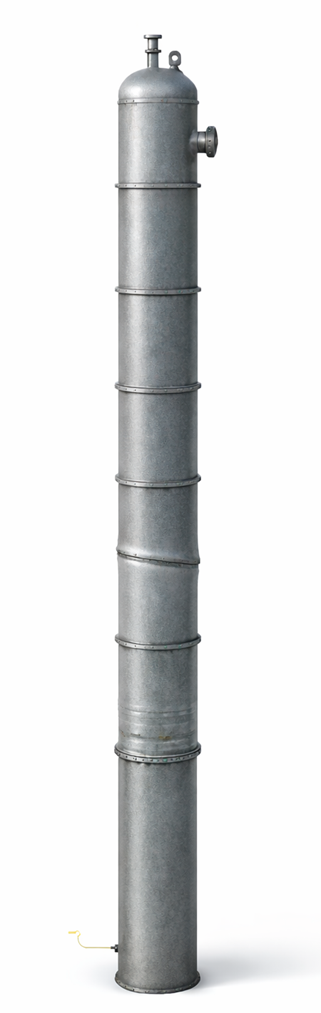
Fig: Representative Image of a Vertical Pressure Vessel Illustrating Weld Misalignment
Level 1 Screening Assessment
The initial Level 1 assessment compares measured shell distortion against the allowable deformation limits specified in API 579-1 / ASME FFS-1, Part 8. For cylindrical shells under internal pressure, the maximum allowable diametrical deviation is limited to a small fraction of the vessel diameter.
In this case, the measured radial distortion exceeded the permissible Level 1 limits. As a result, the vessel does not satisfy Level 1 acceptance criteria.
Level 2 Consideration
Due to the presence of multiple local curvatures within the distorted region, the deformation could not be idealized using simplified geometric representations required for a Level 2 assessment. In accordance with API 579-1 / ASME FFS-1 guidance, the distortion was classified as general shell distortion, rendering Level 2 procedures non-applicable.
Based on this classification, the assessment progressed directly to a Level 3 evaluation.
Level 3 Assessment – Nonlinear Structural Analysis
A Level 3 Fitness-For-Service assessment was conducted in accordance with API 579-1 / ASME FFS-1, Part 8 and Annex 2D. A three-dimensional finite element model of the vessel was developed to explicitly capture the measured shell distortion and weld misalignment.
The model incorporated:
• Actual distorted geometry mapped from inspection data
• Nominal wall thickness reduced by future corrosion allowance
• Elastic-plastic material behaviour with strain hardening
• Nonlinear geometric effects
The following evaluations were performed:
• Elastic-plastic stress analysis under governing load combinations
• Local strain checks against API 579 acceptance limits
• Type 3 elastic-plastic buckling analysis to evaluate structural stability
Wind loading was applied directionally to assess sensitivity to orientation effects.
Key Findings
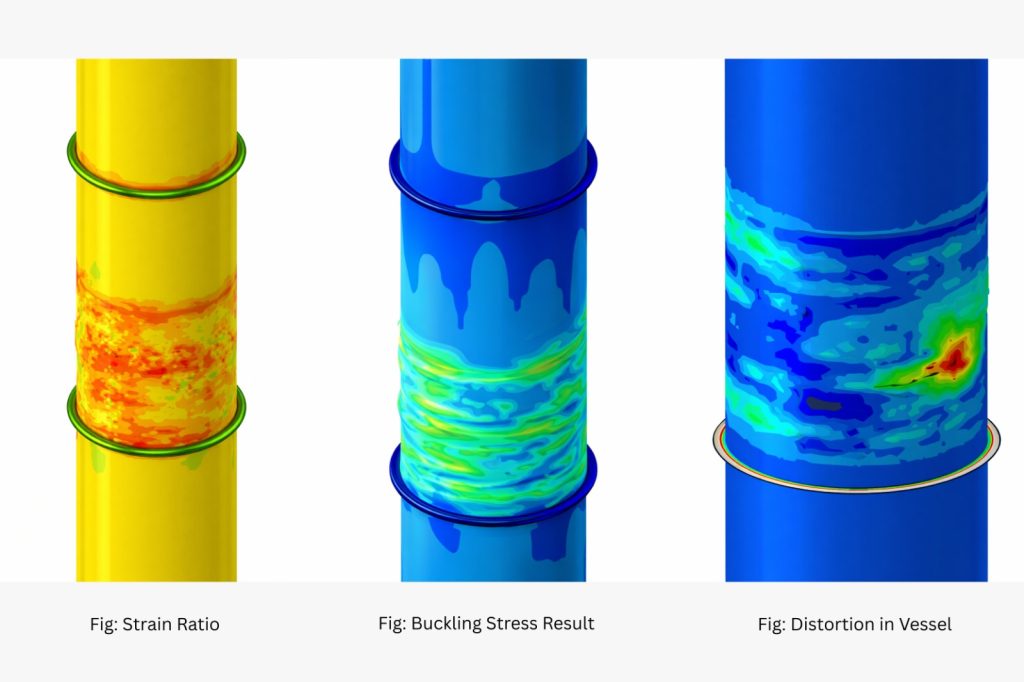
The elastic-plastic analyses converged successfully for all governing load cases, demonstrating protection against plastic collapse. Stress and strain distributions remained within acceptable limits, even in the most highly distorted regions.
Local strain checks confirmed that strain ratios remained below unity throughout the vessel, satisfying the API 579 acceptance criteria for local failure prevention.
The buckling analysis demonstrated adequate structural stability under combined external pressure and wind loading. No loss of load-carrying capacity or instability was observed in the distorted shell region.
Engineering Conclusion
The Level 3 Fitness-For-Service assessment confirms that the observed weld misalignment and general shell distortion do not compromise the structural integrity of the vessel under the evaluated loading conditions.
While simplified screening criteria were exceeded, advanced nonlinear analysis demonstrated that the vessel maintains sufficient strength, ductility, and stability for continued operation.
This case study highlights the importance of progressive Fitness-For-Service methodologies and demonstrates how advanced finite element analysis enables technically sound integrity decisions for geometrically distorted pressure equipment.