
Optimizing Airflow in High-Rise Buildings: A CFD Analysis for Efficient Ventilation – Analyzer CAE Solutions

CFD Analysis of Exhaust Vent Stack Dispersion
April 3, 2025
Enhancing Efficiency & Reliability in Piping Systems
April 17, 2025

Efficient airflow management is essential for maintaining optimal ventilation and thermal comfort in high-rise buildings. With multiple outdoor units (ODUs) operating simultaneously, improper airflow distribution can lead to heat recirculation, reduced cooling efficiency, and increased energy consumption. Computational Fluid Dynamics (CFD) analysis plays a crucial role in evaluating these airflow patterns and identifying potential inefficiencies.
This study focuses on understanding how air moves around ventilation units, how temperature variations occur, and how wind conditions impact overall system performance. By simulating different airflow scenarios, it becomes possible to pinpoint areas of stagnant air, excessive heat buildup, and short-circuiting of hot air between units. The insights gained from this analysis help in optimizing ODU placement, improving airflow paths, and enhancing overall ventilation efficiency. Through strategic modifications, high-rise structures can achieve better cooling performance, reduced energy consumption, and improved indoor air quality, ensuring a more sustainable and efficient built environment.
How CFD (Computational Fluid Dynamics) Impacts High-Rise Ventilation
CFD analysis offers critical insights into how air circulates around various components of a high-rise building. For example, by simulating different scenarios, engineers can identify areas where airflow might become stagnant or where unwanted heat recirculation occurs. These insights allow for:
- Enhanced Design Precision: CFD Analysis helps in fine-tuning the placement and orientation of ventilation units to optimize air distribution.
- Proactive Problem Solving: Potential issues, such as thermal buildup or inefficient airflow patterns, can be addressed during the design phase, reducing the need for costly retrofits.
- Improved Energy Efficiency: By optimizing airflow, buildings can maintain more consistent temperatures with lower energy consumption.
Benefits of Optimized Airflow
Optimizing airflow in high-rise structures provides several tangible benefits:
- Increased Comfort: Consistent and balanced airflow improves indoor air quality, leading to better comfort for occupants.
- Energy Savings: Optimized ventilation reduces the workload on air conditioning systems, lowering energy bills.
- Sustainable Design: Energy-efficient airflow management supports sustainability initiatives and minimizes the environmental footprint of large buildings.
- Long-Term Performance: Strategic placement and configuration of ventilation units ensure that buildings remain efficient over time, adapting to various environmental conditions.
Optimizing Airflow in High-Rise Buildings
The report presents a Computational Fluid Dynamics (CFD) analysis for a high-rise building to study airflow patterns, temperature distribution, and potential issues related to heat recirculation. The objective of the analysis was to evaluate how air moves around various outdoor units, assess temperature variations, and determine if hot air recirculates between units under different conditions. The study involved multiple scenarios with varying airflow conditions to observe their impact on ventilation efficiency.
Advanced simulation tools were used to model the airflow, applying turbulence models to capture airflow behaviour. The building layout, ventilation components, and surrounding obstructions were considered in the analysis. A structured approach was followed, where airflow characteristics were studied across different conditions to identify potential inefficiencies. The simulation revealed variations in airflow behaviour, with some areas experiencing proper ventilation while others showed signs of heat accumulation. Factors such as wind conditions, unit placement, and structural elements influenced temperature variations and airflow distribution.
The findings indicate that strategic placement of ventilation units plays a crucial role in maintaining efficiency. Proper airflow management can help reduce temperature buildup and improve cooling performance. Recommendations include optimizing the arrangement of ventilation components, improving airflow paths, and implementing design modifications to enhance overall performance. The study provides useful insights for improving ventilation efficiency and ensuring better thermal management in similar high-rise structures.
Objectives of the CFD Analysis:
- Analyse airflow distribution and detect short-circuiting of hot air from ODU outlets to inlets.
- Assess coupling effects between multiple ODUs.
- Determine temperature variations at ODU inlets and outlets.
- Study the velocity profile within the domain.
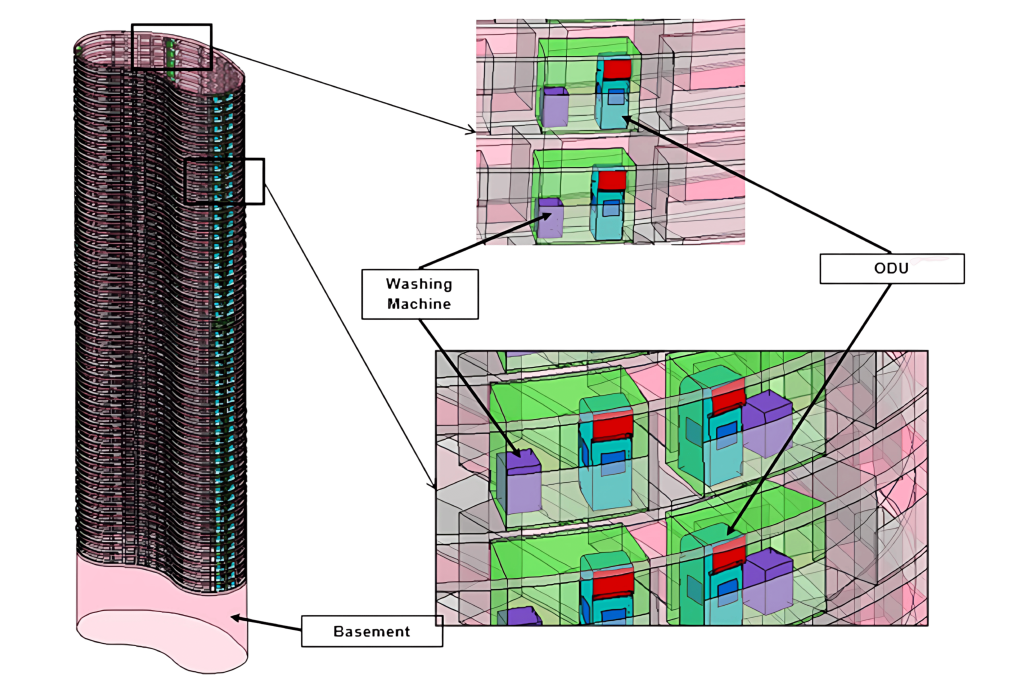
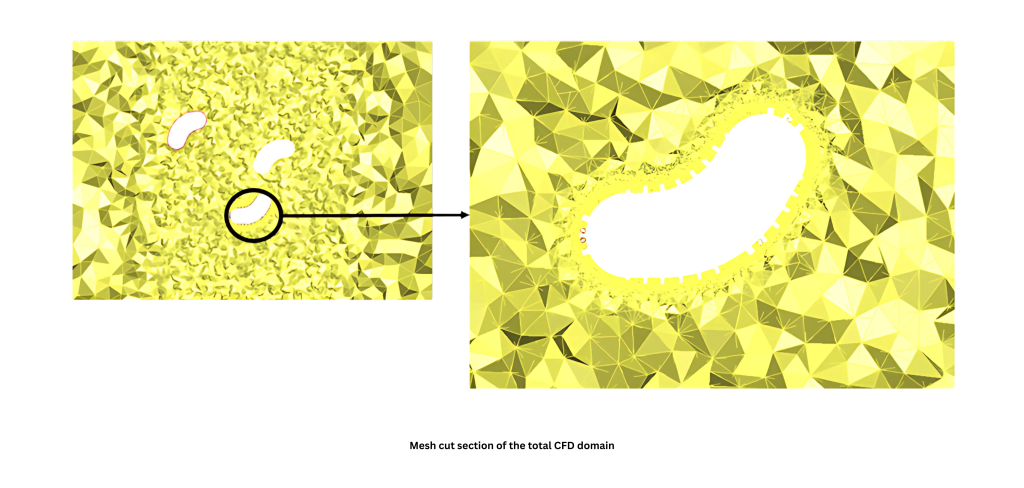
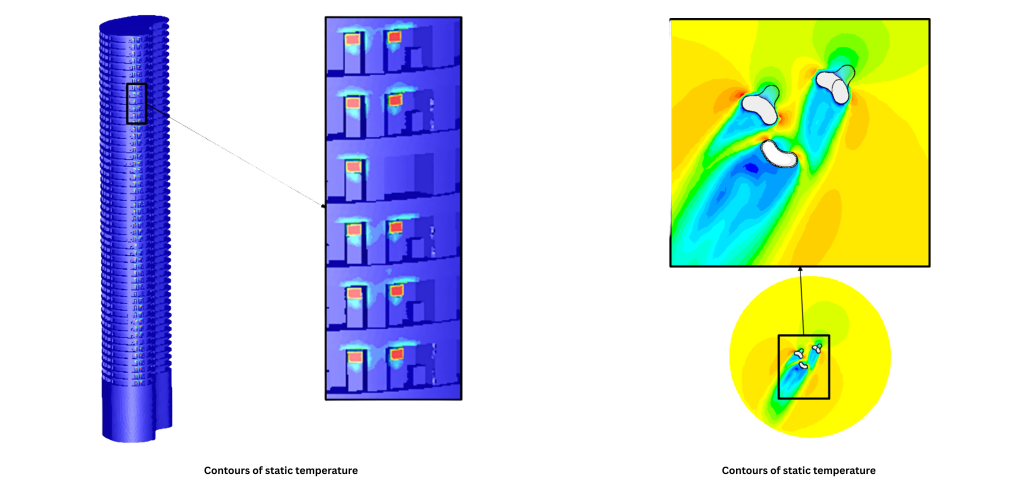
Key Findings:
- Minimal short-circuiting in low-wind conditions, ensuring optimal ODU performance.
- Increased short-circuiting observed at higher wind speeds, leading to hot air recirculation between ODUs.
- Dead zones (areas with stagnant airflow) were identified, affecting the efficiency of some ODUs.
- Maximum temperature rise at inlets ranged between 0.58°C (low wind) to 14.21°C (high wind).
- ODUs in certain zones showed higher short-circuiting and temperature increases.
- Airflow behaviour varied across floors, with mechanical floors and refuge areas affecting circulation.
Conclusions:
- The study highlights the importance of ODU placement to minimize heat recirculation.
- Wind conditions significantly impact cooling efficiency, necessitating strategic airflow management.
- Recommendations include optimized grille design and improved ventilation strategies to enhance ODU performance.
Why Choose Analyzer CAE Solutions?
Analyzer CAE Solutions is a trusted leader in Computational Fluid Dynamics (CFD) analysis, offering innovative simulation solutions across a wide range of industries. From high-rise ventilation and HVAC optimization to external aerodynamics and industrial airflow studies, our tailored analyses provide data-driven insights that drive performance, efficiency, and safety.
We leverage advanced simulation tools, follow global industry standards, and continuously evolve our methods to ensure accurate and reliable results. Every project we handle is unique — whether it’s about improving thermal comfort, optimizing airflow, or enhancing fire safety systems, we deliver customized solutions to meet specific client challenges.
With a strong portfolio of successful projects in HVAC, oil & gas, aerospace, and automotive, Analyzer CAE Solutions empowers clients to:
- Reduce energy consumption
- Improve system efficiency
- Ensure operational safety
Our Core Engineering Services Include:
Advanced CFD Analysis
Decades of experience in airflow studies, HVAC optimization, and external aerodynamics.
Cutting-Edge CFD Simulation Tools
We use the latest simulation software to provide reliable, validated, and high-accuracy results.
Custom Engineering Consulting
Hands-on support for industry-specific challenges in sectors like HVAC, oil & gas, aerospace, and automotive.
Computational Fluid Dynamics Analysis
Detailed modeling of fluid flow and heat transfer to improve design efficiency and system safety.
Globally Compliant Engineering Solutions
Our work aligns with international standards, making us the preferred partner for engineering firms in the USA, Germany, Dubai, and other markets.
Support for Complex Engineering Projects
From conceptual design to final validation, we provide end-to-end support tailored to each project’s unique needs.
Why Choose Analyzer CAE Solutions for CFD Analysis in the USA?
Analyzer CAE Solutions is a trusted provider of CFD analysis and engineering services with a proven track record of delivering precision-driven results across a variety of sectors. We specialize in computational fluid dynamics analysis, offering customized CFD simulation and engineering consulting services tailored to the specific needs of clients in the USA.
From high-rise ventilation and HVAC system optimization to external aerodynamics and industrial airflow simulation, we deliver high-value engineering solutions that improve performance, efficiency, and safety. Whether you’re managing complex engineering projects in aerospace, oil & gas, or automotive industries, our team ensures accurate insights using cutting-edge CFD simulation tools.