
Background
Brittle Fracture Assessment of a Vertical Pressure Vessel. Older pressure vessels constructed before mandatory impact testing requirements often present an increased risk of brittle fracture, especially during low-temperature operation. Engineers frequently encounter this concern when evaluating legacy refinery equipment exposed to cold startup, shutdown, or depressurisation conditions.
This case study evaluates a vertical distillation column constructed in accordance with ASME Section VIII, Division 1. The study examines whether the vessel can safely operate at low temperatures without the risk of brittle fracture. The assessment uses a staged Fitness-For-Service (FFS) methodology supported by stress analysis and fracture mechanics principles.
Vessel and Operating Scenario
The vessel uses a carbon steel pressure vessel material commonly applied in refinery service. Material impact test data is unavailable due to the vessel’s construction era. The shell and head have identical nominal thicknesses, and fabrication included post-weld heat treatment.
The assessment assumes no metal loss, cracking, or active degradation mechanisms. The vessel operates at elevated pressure during normal service. However, depressurised conditions expose the shell to very low temperatures driven by ambient and process effects.
The coldest credible condition defines the Critical Exposure Temperature (CET). This temperature falls well below freezing and governs the brittle fracture evaluation.

Assessment Philosophy
This evaluation follows Fitness-For-Service principles in accordance with API 579 / ASME FFS-1, Part 3. The assessment progresses through Level 1, Level 2, and Level 3 procedures as required by acceptance criteria.
The assessment objectives are to:
• Establish the Minimum Allowable Temperature (MAT) based on material, thickness, and fabrication history
• Compare the MAT with the Critical Exposure Temperature (CET)
• Escalate the assessment level only when lower-level criteria are not satisfied
This staged approach maintains conservatism while avoiding unnecessary analytical complexity.
Level 1 and Level 2 Assessment
The initial Level 1 screening determines the MAT using governing thickness and applicable material exemption curves. The calculated MAT exceeds the CET. As a result, the vessel does not satisfy Level 1 acceptance criteria.
Engineers then perform a Level 2 assessment to reduce conservatism. This assessment incorporates:
• Required thickness under internal pressure
• Stress ratio evaluation
• Temperature reduction factors accounting for stress utilisation
The Level 2 analysis produces MAT values as a function of operating pressure. Despite these refinements, the CET remains lower than the governing MAT. Therefore, Level 2 methods cannot exclude brittle fracture risk.
Level 3 Assessment – Fracture Mechanics Approach
Engineers perform a Level 3 brittle fracture assessment using fracture mechanics principles to further refine the evaluation. The analysis postulates conservative surface-breaking flaws at critical shell and nozzle locations. These flaws represent the worst-case undetected defects.
Finite Element Analysis (FEA) determines:
• Primary membrane and bending stresses
• Stress distributions near and away from structural discontinuities
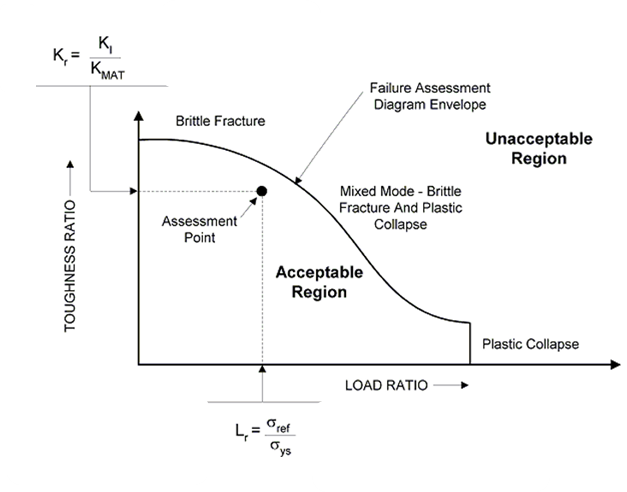
The assessment uses these stresses to calculate load ratios and stress intensity parameters. Engineers then evaluate these parameters using a Failure Assessment Diagram (FAD) framework.
Key Findings
• The cylindrical shell away from nozzles remains within the acceptable region of the Failure Assessment Diagram at the defined CET. This result demonstrates adequate fracture resistance in the shell course.
• One nozzle-to-shell junction governs the overall MAT for the vessel. This location produces the most restrictive assessment result.
• Reducing the assumed flaw size at the nozzle significantly improves the fracture margin. This outcome highlights the sensitivity of brittle fracture risk to flaw assumptions and inspection reliability.
Engineering Conclusion
• The assessment confirms that simplified screening methods introduce excessive conservatism for this vessel. In contrast, the fracture mechanics-based Level 3 evaluation establishes a technically defensible low-temperature operating envelope.
• The vessel can remain fit-for-service at low temperature, provided that inspection reliability, operating controls, and conservative flaw assumptions are maintained.
• This case demonstrates the value of progressive Fitness-For-Service assessments and underscores the role of FEA-supported fracture mechanics in integrity decisions for aging pressure equipment.