
# Introduction
Traditional car parks have ducted ventilation systems. These systems are quite inefficient as they cater to the entire car park area even though the ventilation requirement is only for a small part of the basement. Modern car parks have jet fans, which help minimize energy consumption due to their efficient design.
CFD is widely used to determine the number of jet fans, location of jet fans in the Car park so that the system works efficiently in ventilation mode and fire mode.
In ventilation mode the jet fans help in moving the high CO towards the exhaust, hence reducing the CO level in the basement. In case of fire, the jet fans move the smoke from the place of fire to the exhaust location, hence improving the visibility in the car park area.
# Challenges
- Determining the optimum number of jet fans and their location.
- Simulating the fire and determining the emergency philosophy for efficient smoke
- Identifying the appropriate no of Zones within the Basement & defining an efficient control sequence for CO sensors & Jet
# Solution
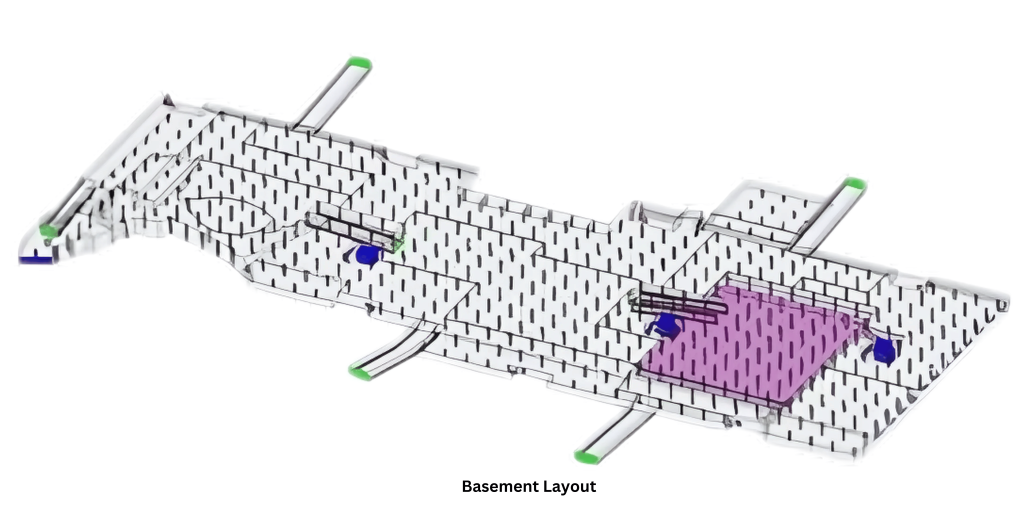
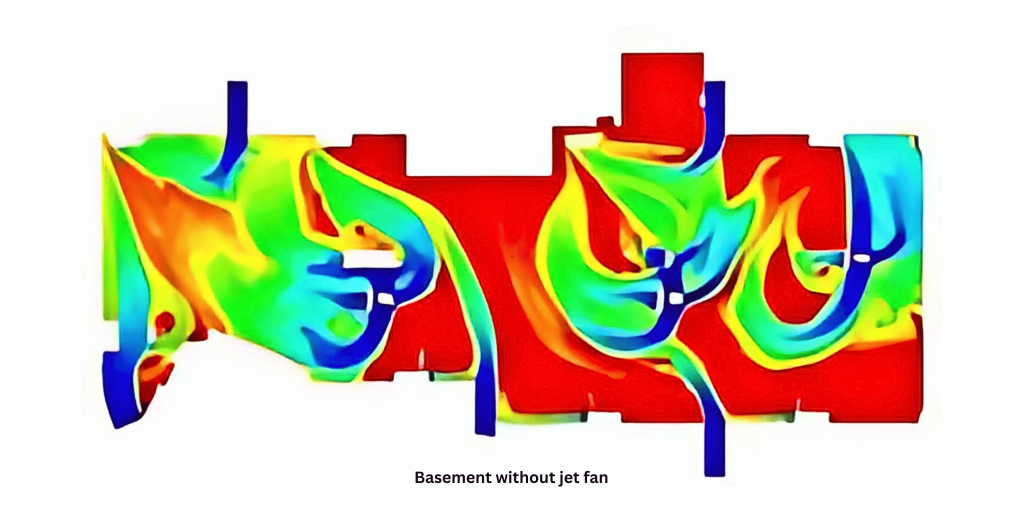
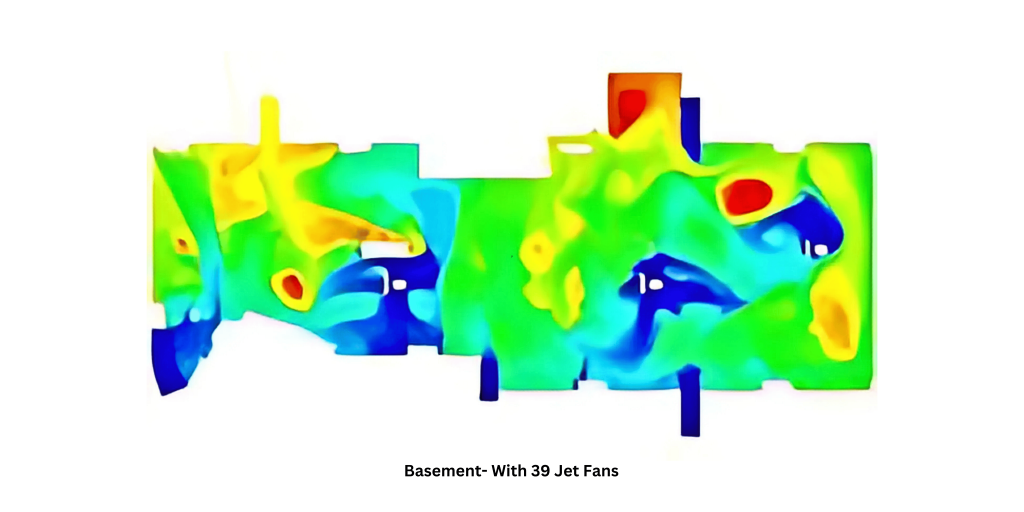
It is very important to create a 3D model that replicates the actual car park and specifies the locations of fresh air supply and exhaust. Initially, a CFD simulation is carried out without any jet fans to check the concentration of CO. Based on the CO concentration, the number of jet fans and their locations are decided.
Further CFD simulations are carried out to optimize the system. Once the system is optimized, the number and locations of jet fans are frozen. A fire simulation is carried out to determine the transient behavior of smoke in the car park. Once the emergency system is switched on, the direction and time taken to remove the smoke from the basement are determined.
# Benefits
- Virtual testing of the car park for ventilation and fire scenarios.
- Cost estimation for the Car park ventilation
- Design optimization of system for efficient