
Introduction
Shelters are the structures used in military applications. Their function is to provide housing for different equipment serving different applications. Considering the applications, the structures need to be verified for its strength against different loading conditions. This evaluation can be well performed by FEA. FEA gives better understanding about the actual behaviour of shelter assembly under different operating conditions whether they are static or dynamic in nature. Some external excitations may lead to resonance conditions. This condition needs to be avoided by some design modifications. By virtue of modal analysis, FEA evaluate the structure for any such a condition.
Shelter manufacturer from India, well known for its work for INDIAN DEFENSE, approached ANALYZER to seek assistance in evaluating the design of their newly developed shelter assembly against different loading conditions.
Workflow
• In case of shelters, based on design standards of this structures, the material properties are provided by client itself.
• Preparing FEA Model for shelter assembly. Here the meshing approach is great challenge for a FEA engineer as it needs structural understanding to simplify the structure without losing its strength & stiffness.
• Solving the FEA model for different loading conditions in ANSYS APDL Solver. These conditions include static as well as dynamic loading conditions.
• Report the results for client’s reference.
SOLUTION
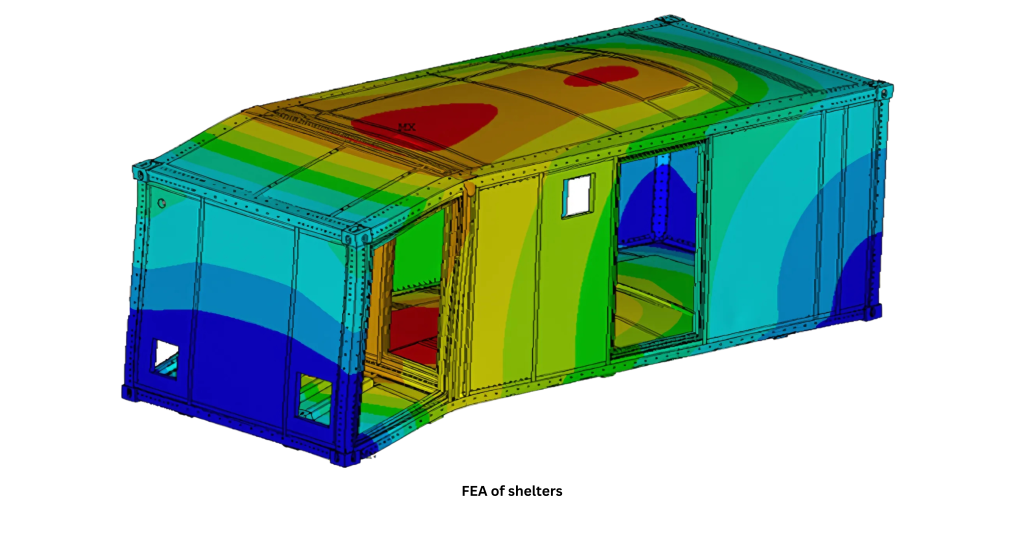
The shelter assembly was analysed using Finite Element Method for different loading conditions. The FEA model is created by simplifying the components without compromising their strength & stiffness. The bolted, welded connections are modelled with appropriate assumptions & element types.
The results showed that the induced stresses are within the allowable limit for both static as well as dynamic loading conditions. Also, it do not possess any mode that will cause resonance. Hence the structure is predicted to behave safe during service life without any premature failure.
BENEFITS
• Considering severity of its application, the safety of shelter assembly can be evaluated to a greater extend.
• Design modifications are made possible without testing a prototype, thus reducing the time to manufacture of the structure.