
Background
HIC Fitness-For-Service Assessment, A high-pressure separator vessel constructed in 1980 in accordance with ASME Section VIII, Division 2 was subjected to detailed inspection following concerns related to low-temperature hydrogen damage. The vessel operates under high internal pressure and elevated temperature, making hydrogen-related degradation a critical integrity concern.
Automated Ultrasonic Testing (AUT) and Phased Array Ultrasonic Testing (PAUT) identified a localized zone of Hydrogen Induced Cracking (HIC) near the junction of the top hemispherical head and the cylindrical shell. Due to the proximity of this damage to a structural discontinuity and the nature of the degradation mechanism, a Level 3 Fitness-For-Service assessment was required.
Vessel and Operating Data
The vessel shell material is SA-516 Grade 70, stress-relieved by post-weld heat treatment (PWHT). The separator was designed for high internal pressure with a large internal diameter, and it continues to operate close to its design envelope.
The cylindrical shell thickness is significantly greater than the hemispherical head thickness, which plays a key role in stress redistribution at the shell-to-head junction. No future corrosion allowance was specified, and the original corrosion allowance had already been consumed.
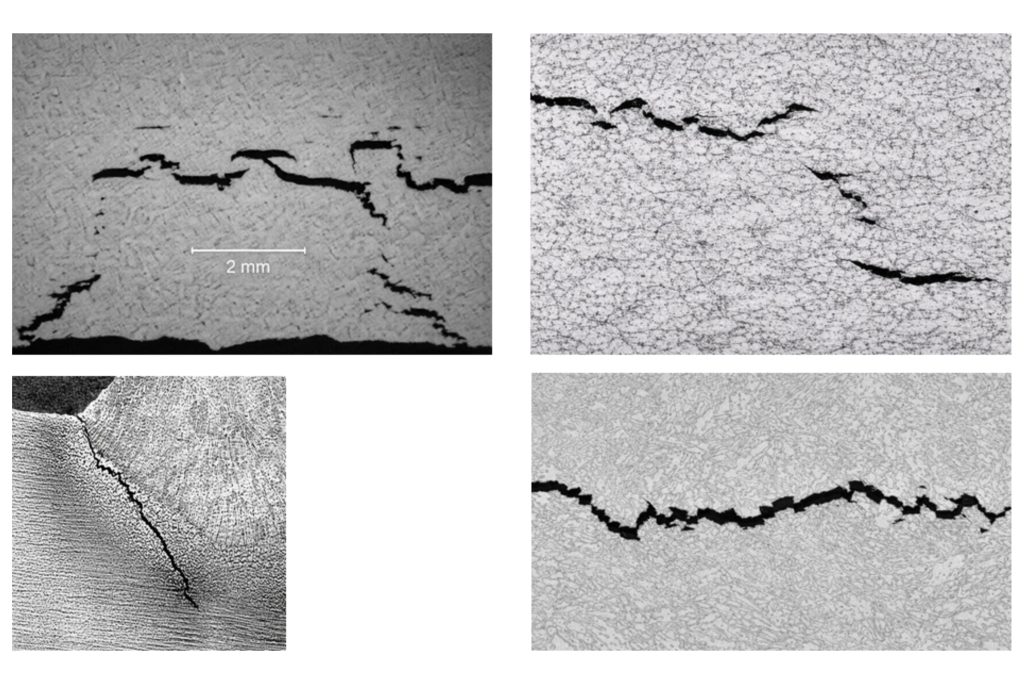
Inspection Findings and Damage Characterization
Inspection revealed a single HIC damage zone with a clearly defined axial and circumferential extent. The damage was located approximately 10 inches below the top head-to-shell junction, intersecting the longitudinal weld seam.
Key observations included:
- Subsurface cracking with limited surface expression
- Reduced through-thickness load-carrying capability in the damaged region
- No evidence of multiple interacting HIC zones
Due to insufficient spacing from the nearest structural discontinuity, the damage did not meet Level 1 or Level 2 screening criteria, necessitating a full Level 3 evaluation.
Level 3 Assessment Methodology
1 Finite Element Analysis (FEA)
An axisymmetric finite element model was developed for the top head and cylindrical shell junction in accordance with API 579-1 Annex 2C. Both damaged and non-damaged regions were explicitly modelled.
- Undamaged regions were assigned elastic-plastic material behaviour with strain hardening
- The HIC-affected region was conservatively modelled as elastic-perfectly plastic
- The HIC damage was assumed to extend circumferentially around the vessel
Internal pressure loading corresponding to the design pressure envelope was applied to the internal surfaces.
Convergence of the nonlinear elastic-plastic analysis was used as the acceptance criterion for protection against plastic collapse.
4.2 Fracture Mechanics Evaluation
To address fracture risk, a detailed fracture mechanics assessment was conducted in accordance with API 579-1 Part 9 using the Failure Assessment Diagram (FAD) approach.
Key aspects of the fracture evaluation included:
- Estimation of material fracture toughness using lower-bound arrest toughness correlations
- Inclusion of weld residual stresses as per API 579 Annex 9D
- Evaluation of both longitudinal and circumferential embedded crack-like flaws, with lengths equal to the measured HIC zone dimensions
Primary membrane and bending stresses obtained from FEA were used to calculate the load ratio (Lᵣ), while fracture toughness data were used to calculate the toughness ratio (Kᵣ).
5. Assessment Results
The elastic-plastic analysis demonstrated stable convergence for the governing load case, confirming protection against plastic collapse.
Fracture mechanics results showed that:
- Assessment points for both axial and circumferential crack orientations fell within the acceptable region of the FAD
- The vessel is protected against brittle fracture under current operating conditions
Based on these results, the vessel satisfies the API 579-1 Part 7 Level 3 acceptance criteria in its current damaged state.
6. Engineering Conclusions and Recommendations
- The vessel is fit for continued operation under current pressure and temperature conditions.
- Both plastic collapse and fracture failure modes are adequately controlled.
- Sensitivity analysis indicates that increasing HIC zone size or lower operating temperatures could reduce remaining margins.
- The Minimum Allowable Temperature (MAT) for the current condition was determined, governed by fracture mechanics limits.
Periodic monitoring of hydrogen charging conditions and in-service inspection of the damaged region is recommended to track potential damage progression. Mitigation measures such as process control or barrier coatings may be considered to limit future HIC growth.