
Background
Local Thin Area Fitness-For-Service Assessment, Localized thinning of pressure vessel shells is a common integrity concern, particularly in aging equipment exposed to corrosive process environments. Unlike general metal loss, Local Thin Areas (LTA) involve confined regions of wall thickness reduction. These regions can significantly influence local stress distribution while the surrounding shell remains largely unaffected.
This case study presents a Fitness-For-Service (FFS) evaluation of a cylindrical pressure vessel containing a single localized thin area identified during inspection. The objective of the assessment was to determine whether the vessel could continue operating safely under design conditions or whether pressure de-rating or repair would be required.
Vessel and Operating Scenario
The vessel was assumed to be constructed in accordance with ASME Section VIII, Division 1 and fabricated from carbon steel commonly used in high-temperature pressure vessel service. The vessel operated under internal pressure loading only, with no significant supplemental loads from attached piping, supports, or external restraints.
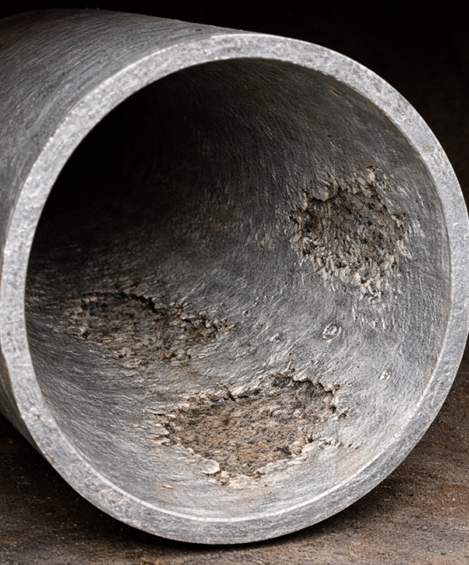
Routine inspection identified a single localised corrosion region located away from major structural discontinuities such as nozzles, heads, or weld intersections. No additional degradation mechanisms were observed elsewhere on the vessel.
Inspection Data and Damage Characterization
A detailed thickness survey was performed over the affected region to establish the Critical Thickness Profile (CTP) in the longitudinal direction. Based on inspection coverage and field observations, the circumferential extent of the thinning was approximated as a rectangular region.
The localized thin area exhibited the following characteristics:
• A smooth reduction in thickness toward a minimum value at the centre
• Symmetric recovery of thickness away from the thinnest location
• No evidence of cracking, pitting, or plastic deformation
• Location sufficiently distant from structural discontinuities
Based on component geometry and loading conditions, the vessel shell was classified as a pressure-controlled shell component suitable for localized thinning assessment.
Assessment Philosophy
The evaluation followed Fitness-For-Service principles in accordance with API 579 / ASME FFS-1 Part 5, using a structured Level 2 assessment methodology appropriate for Local Thin Areas.
The assessment aimed to:
• Quantify the severity of localized thinning using inspection data
• Evaluate remaining strength while accounting for stress redistribution
• Determine acceptability at the original design pressure
• Identify the need for pressure de-rating or repair
This methodology provides a realistic evaluation while maintaining appropriate engineering conservatism.
Level 2 Local Thin Area Assessment
The Level 2 assessment included the following steps:
• Establishing the governing wall thickness for analysis
• Identifying the minimum measured thickness within the CTP
• Defining the longitudinal and circumferential dimensions of the LTA
• Calculating the Remaining Strength Factor (RSF) by subdividing the thickness profile into multiple evaluation sections
The RSF calculation accounted for:
• Reduction in load-carrying area within the LTA
• Redistribution of membrane stresses across the thinned region
• Influence of shell geometry through applicable shell parameters
The minimum RSF occurred at the location of maximum metal loss and governed the assessment outcome.
Results and Engineering Evaluation
The calculated RSF fell below the acceptance criterion required for continued operation at the original design pressure. This result indicated that the localized thinning reduced the vessel’s pressure-containing capability below its original design basis.
Based on the assessment results:
• The longitudinal extent of the LTA was unacceptable at design pressure
• A reduced Maximum Allowable Working Pressure (MAWP) was calculated
• Circumferential extent checks confirmed that no further refinement was required
Engineering Conclusion
The Level 2 Fitness-For-Service assessment concluded that the vessel was not acceptable for continued operation at the original design pressure due to the severity of localized thinning. However, the assessment demonstrated that safe operation is feasible at a reduced MAWP, provided that no additional degradation occurs.
This case highlights how localized thinning can govern vessel integrity even when average wall thickness appears adequate. It reinforces the importance of detailed inspection data and RSF-based evaluation for informed integrity management decisions.