

FEA of Expansion Joint of Heat Exchanger
April 7, 2023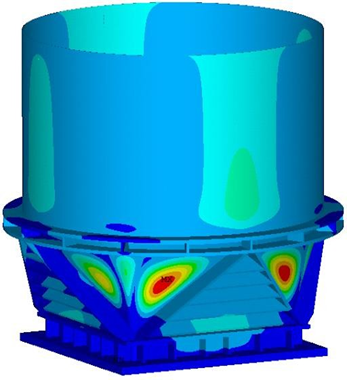
Elastic Plastic Stress Analysis
April 7, 2023INTRODUCTION
Process equipment are subjected to higher temperatures during their service life. This higher temperature causes thermal stresses in various parts of the equipment. Excessive differential expansion of the equipment, sometimes leads to its failure. Hence such severe conditions needs to be analyzed in order to ensure safety of the equipment.
WORKFLOW
Determining the material properties for different MoCs of equipment, design/operating conditions.
Preparing FEA Model for two different cases – Body temperature development & Static Structural analysis.
Solving the model for body temperature with the effect of insulation taking into consideration. Here thermal conductivity is provided over a temperature range.
Solving the model in order to calculate the thermal stresses. Here the thermal expansion coefficient of materials is provided over a temperature range.
Results extractions & combining the results with other loadings in order to get the desired combinations.
Report the results for client’s reference.
CHALLENGES
Capturing the effect of insulation in FEA without actually modelling the same,
Inserting the body temperature data into structural analysis without any loss.
SOLUTION
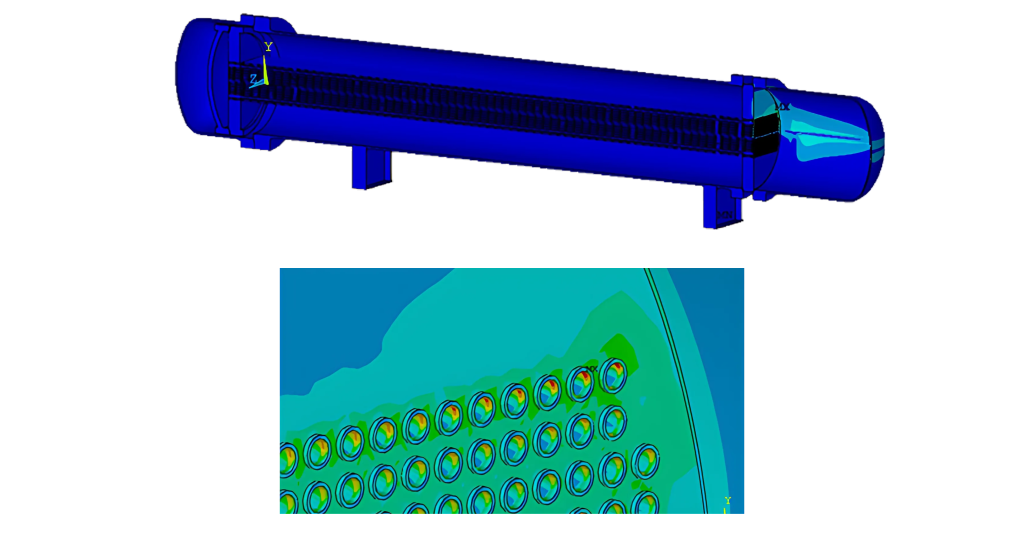
The equipment (Pressure vessel/Heat exchanger) was analyzed using Finite Element Method to determine the induced stresses due to differential thermal loading. In order to assess structural strength of the equipment, guidelines from ASME BPVC (Boilers & Pressure Vessels Code) Section VIII Div. 2 part 5 was utilized. For Thermal analysis, as secondary stresses are induced in the geometry hence membrane stresses are not evaluated. The induced stresses are observed to be within the allowable limit. Hence, the structure’s design was predicted to behave safe during operation without premature failure.
BENEFITS
•Better understanding about operating conditions of the equipment
•Design modification based on actual behavior of the structure is made possible
•Reduced manufacturing time