

FEA in Pressure Vessel – FEA Analysis
December 30, 2024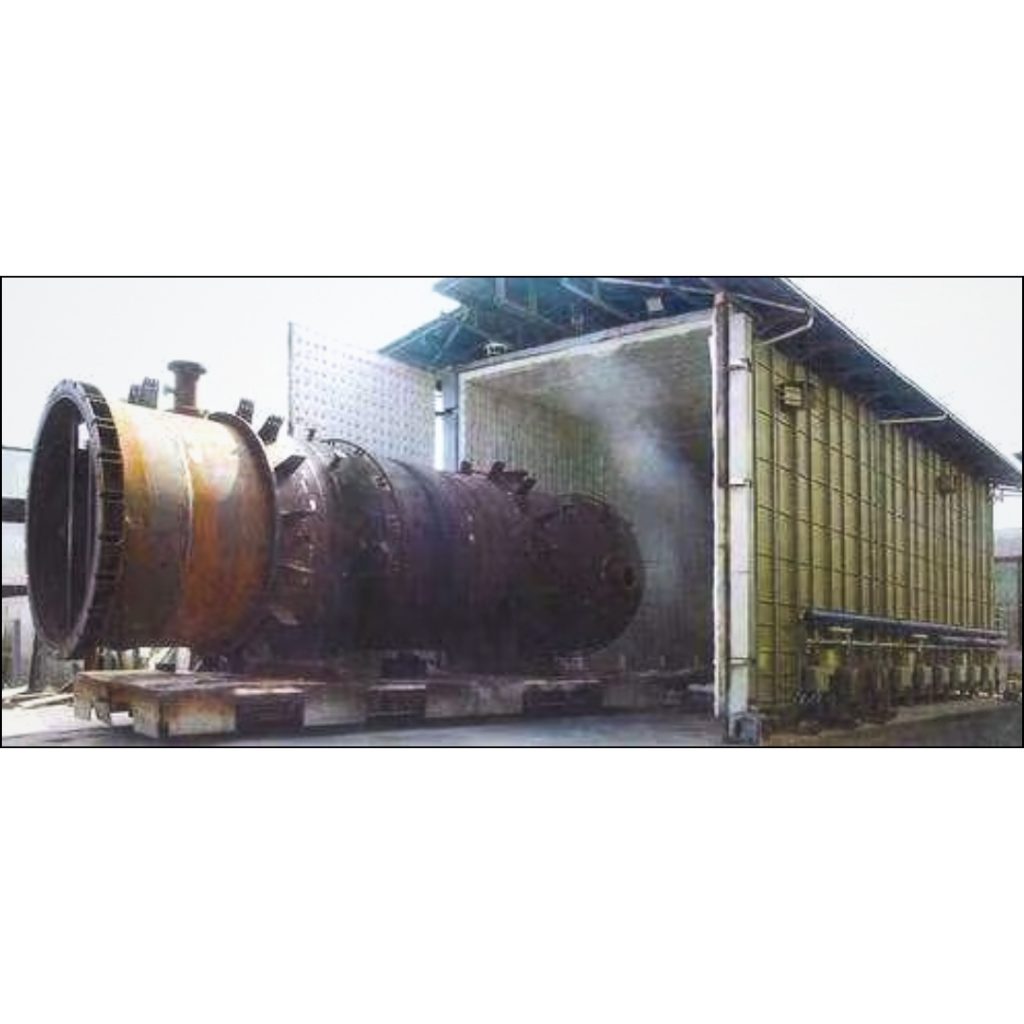
FEA Under PWHT Conditions
Technical insight from Analyzer CAE Solutions covering engineering simulation, design validation and practical CAE applications for industrial decision-making.
Introduction
In many welding procedures, post-weld heat treatment, or PWHT, is an essential step that guarantees the performance and integrity of welded components. PWHT helps to improve the material properties of the welds, reduce residual stresses, and avoid cracking in structural steel, pipelines, and pressure vessels.
In industry now it becomes usual practice to simulate PWHT in Finite Element Analysis to optimize process and more accurate control. In this article we will examine FEA advantages, difficulties and practical uses in PWHT.
What is PWHT?
Post-weld heat Treatment (PWHT) refers to a set of thermal treatments applied to a welded material to enhance its properties after the welding process. The primary goals of PWHT include:
- Stress Relief: Reducing residual stresses generated during the welding process that may lead to cracks, distortions, or failures.
- Microstructure Improvement: Altering the microstructure of the welded material to increase strength, toughness, and ductility.
- Preventing Cracking: Particularly for high-strength steels and alloys, PWHT helps in reducing the risk of cracking during cooling.
Industries such as aerospace, oil & gas, automotive, and pressure vessel manufacturing rely heavily on PWHT to ensure the structural integrity of welded joints.
What is FEA?
Finite Element Analysis (FEA) is a powerful numerical method used to solve complex problems in engineering, particularly when analysing stress, heat, and deformation in materials. FEA breaks down a large, complex structure into smaller, manageable “elements,” solving for different physical behaviours like temperature distribution, strain, and stress at each element.
In the context of PWHT, FEA is used to simulate the thermal and mechanical behaviour of a weldment as it undergoes heating and cooling. This allows engineers to predict potential problems such as distortion, cracking, or undesirable material properties, helping them optimize the PWHT process before it’s carried out physically.
How FEA Enhances PWHT
There are many benefits of incorporating FEA into the PWHT process, such as:
1. Temperature Profile Simulation: To help design the optimal heating cycle, FEA can simulate the temperature distribution inside the welded component during heating and cooling.
2. Residual Stress Analysis: Weld problems are frequently caused by residual stresses in the weld zone, which engineers can forecast using FEA. This makes it possible to make specific changes to reduce stress-related problems.
3. Distortion Prediction: For large, complex welded structures, FEA is very useful in anticipating geometric distortions that may occur during the cooling phase.
4. Material Property Prediction: Due to temperature fluctuations during PWHT, FEA can predict changes in material characteristics (such as strength or hardness). This ensures that the final properties meet design specifications.
Ultimately, using FEA for PWHT leads to more reliable, efficient, and cost-effective welding operations by optimizing the heat treatment process and reducing the need for trial and error.
Types of FEA Analysis for PWHT
Several types of FEA analysis are particularly useful for optimizing the PWHT process. Let’s take a closer look at the key types:
1. Thermal Analysis
- Purpose: To simulate the temperature distribution during the heating and cooling phases.
- Application: By simulating how heat propagates through the welded joint, engineers can ensure that the heat treatment is applied uniformly, preventing overheating or underheating.
2. Residual Stress Analysis
- Purpose: To predict and quantify the residual stresses within the welded material.
- Application: Residual stresses often lead to cracking or warping in welded components. FEA helps in identifying areas of high-stress concentration, allowing for adjustments in the heating process.
3. Distortion Analysis
- Purpose: To predict geometric distortions caused by uneven heating and cooling.
- Application: Distortion is a common issue during PWHT, especially for large, welded structures. FEA can predict how the structure will deform, allowing engineers to adjust the heat treatment or design to minimize distortion.
Benefits of Using FEA in PWHT
Integrating FEA in the PWHT process offers several key benefits:
- Precision: FEA provides highly accurate simulations, allowing for fine-tuned control over the heat treatment process, which is critical for maintaining weld quality.
- Cost-effective: By simulating the process, engineers can avoid costly physical trials, reducing both material waste and labour costs.
- Optimization: FEA helps in identifying the best heating and cooling schedules, which not only improve material properties but also prevent issues like cracking and distortion.
- Time-saving: Engineers can test multiple scenarios and optimize the process in a virtual environment, saving significant time compared to traditional trial-and-error methods.
Challenges and Considerations
While FEA is a powerful tool, there are some challenges when using it for PWHT:
- Complexity of Models: Modelling the heat treatment process requires accurate material properties, boundary conditions, and geometry. Complex weldments may require advanced models to predict behaviour accurately.
- High Computational Demand: FEA simulations, especially for large or intricate welded structures, can require significant computational power and time.
- Data Accuracy: The success of an FEA simulation heavily relies on the accuracy of input data, such as thermal conductivity, specific heat, and material properties at varying temperatures.
Analyzer experience in this type of analysis. Example,
1. Introduction: 1.Introduction: Analyzer specializes in Finite Element Analysis (FEA) to ensure the structural stability and reliability of engineering components. One such analysis involves assessing the stability of a Sour Condensate Flash Drum under Post Weld Heat Treatment (PWHT) conditions. This evaluation is crucial for determining the pressure vessel’s ability to withstand thermal stresses and maintain its integrity during operation.
The primary objective of this analysis is to verify the structural stability of the pressure vessel during PWHT. By simulating real-world conditions, FEA helps identify potential weaknesses and ensures the vessel meets safety and performance standards before being put into service. The analysis follows industry-recognized codes and standards to maintain accuracy and compliance. The design is evaluated based on ASME Section VIII Division 1 and 32-SAMSS-004_01, ensuring adherence to established safety and operational guidelines. The structural analysis is conducted in accordance with ASME Section VIII Division 2, which provides a more detailed assessment of stress distribution and load-bearing capacity.
By leveraging advanced simulation techniques, Analyzer helps industries optimize their designs, enhance safety, and minimize risks associated with high-pressure operations. These analyses play a crucial role in ensuring regulatory compliance, preventing failures, and improving the overall reliability of pressure vessels in various industrial applications.
2. FEA Objective: The Finite element analysis is carried out for PWHT to check the stability of the pressure vessel.
3. Code and standards
- Design Code: ASME Sec VIII Div. 1 & 32-SAMSS-004
- Analysis Code: ASME Sec VIII Div. 2
FEA for PWHT:
-Geometry:

Thermal Profile Simulation:
To ensure the stability of the pressure vessel during Post Weld Heat Treatment (PWHT), a steady-state thermal simulation is conducted as part of the Finite Element Analysis (FEA). This simulation helps assess the thermal profile of the vessel, identifying temperature distribution and potential stress concentrations that may arise during the heating and cooling process. By evaluating these factors, the analysis ensures that the vessel can withstand thermal stresses without compromising its structural integrity. Thermal profile simulation plays a crucial role in predicting how the material will respond to temperature variations, helping engineers optimize the design and enhance operational safety. This process ensures compliance with industry
standards and minimizes the risk of deformation or failure. By leveraging advanced simulation techniques, Analyzer helps industries maintain the reliability and longevity of pressure vessels in high-temperature applications, reducing potential operational risks and ensuring efficient performance.

Fig: Thermal
– Structural Analysis:
To assess the impact of Post Weld Heat Treatment (PWHT) on the pressure vessel, a structural analysis is conducted using the temperature profile obtained from the steady-state thermal simulation. This analysis helps evaluate deformation caused by thermal expansion and contraction, ensuring the vessel maintains its structural integrity under varying temperature conditions.
By simulating real-world thermal effects, the structural analysis identifies potential weak points, stress concentrations, and areas susceptible to deformation. This allows engineers to validate the vessel’s design and make necessary modifications to enhance durability and performance. Structural analysis is essential in ensuring the reliability of pressure vessels exposed to high temperatures. By integrating thermal and structural simulations, Analyzer provides a comprehensive assessment, helping industries optimize design, improve safety, and reduce the risk of operational failures.
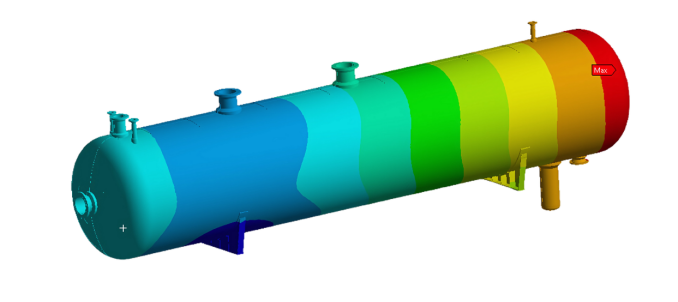
Fig: Total deformation
– Buckling Analysis:
During Post Weld Heat Treatment (PWHT), the heating process causes the pressure vessel material to soften, increasing the risk of buckling failure. Elevated temperatures can reduce the material’s strength, making it more susceptible to deformation under applied loads. To ensure the vessel’s structural stability, a thorough buckling assessment is essential. The ASME standards provide specific guidelines for evaluating the risk of buckling in pressure vessels subjected to such conditions. ASME Section VIII Division 2,particularly Para 5.4.1.2, outlines different assessment methods to determine whether the design can withstand buckling failure. These guidelines help engineers analyse critical load conditions and implement necessary design modifications to enhance safety and durability. By following these standards, Analyzer ensures that pressure vessels maintain their integrity under PWHT conditions, reducing the risk of failure and improving overall reliability. Advanced simulations and compliance with industry codes help optimize vessel performance in high-temperature environments.

Fig: Mode shape
– Elastic-Plastic Analysis:
To assess the pressure vessel’s resistance to buckling failure, an elastic-plastic stress analysis is performed in accordance with Clause 5.4.1.2(c) of ASME Section VIII Division 2. This analysis considers the applicable loading conditions outlined in Table 5.5 of the ASME standard to ensure accurate evaluation under real-world operational scenarios. The process begins with an Eigenvalue Buckling analysis, which helps identify the critical buckling modes and deformation patterns of the vessel. The deformed model obtained from this analysis is then used as the basis for further elastic-plastic stress evaluation, providing a more detailed assessment of how the material behaves under combined thermal and mechanical loads. By integrating these advanced simulation techniques, Analyzer ensures that pressure vessels meet industry safety standards, reducing the risk of buckling failure. This comprehensive approach helps enhance the reliability, durability, and overall performance of vessels operating under high-temperature and high-pressure conditions.

– Scope Of Design Improvement
o Providing additional external supports.
o Installing internal spider supports.
o lowering the PWHT temperature to a predetermined point.
Why Choose Analyzer?
Analyzer leverages the power of Finite Element Analysis (FEA) to optimize the PostWeld Heat Treatment (PWHT) process, transforming how welding engineersapproach heat treatment procedures. By integrating FEA into your operations,Analyzer ensures that welded components meet the highest standards for strength,safety, and durability. Our advanced simulations accurately model temperaturedistributions, predict residual stresses, and analyse potential distortions, providingreliable predictions that help optimize the overall welding process.No matter the industry—whether aerospace, oil and gas, or structuralfabrication—Analyzer’s expertise in FEA enhances your welding operations byimproving quality and performance. We focus on delivering precise, actionableinsights that not only elevate the quality of your work but also help reduce costs,increase productivity, and enhance safety. Choose Analyzer for a comprehensiveapproach to ensuring your welding operations are more efficient, cost-effective, andreliable.