
Defence Engineering Services: The Role of Simulation Analysis
June 28, 2025
Shaping Soundscapes Through Acoustic Expertise
September 11, 2025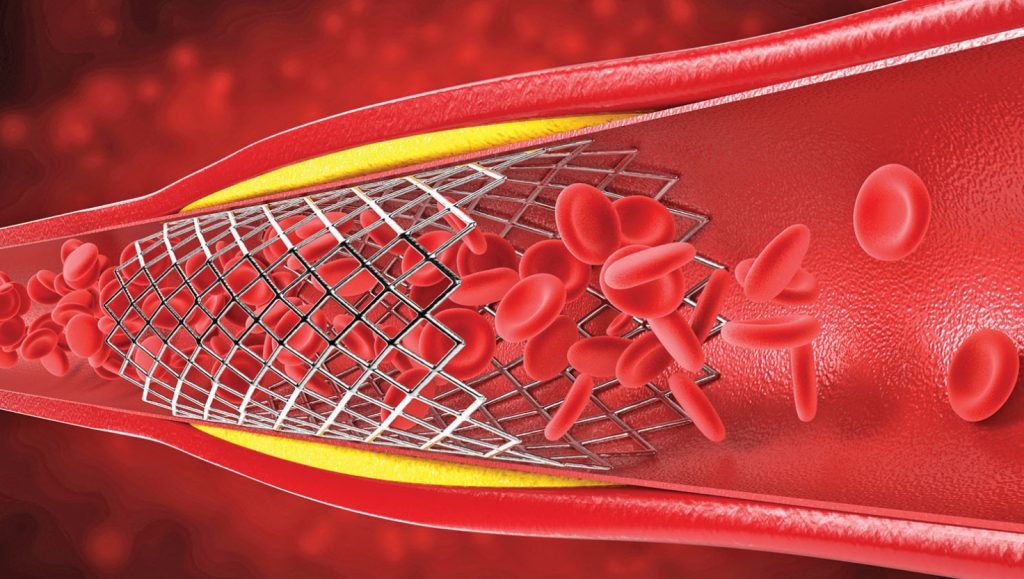
How Advanced Computer Aided Engineering (CAE) from Engineering Services Companies Is Revolutionizing Medical Innovation
Technical insight from Analyzer CAE Solutions covering engineering simulation, design validation and practical CAE applications for industrial decision-making.
Introduction
As the healthcare industry continues its rapid transformation, driven by the need for safer, more personalized, and faster-to-market solutions, engineering simulation is emerging as a vital tool. Computer-Aided Engineering (CAE) is no longer just a manufacturing tool it is a catalyst for innovation in medical devices, biomechanics, and patient-specific healthcare planning.
This blog explores how CAE is being used to transform the medical industry, reduce development cycles, enhance device performance, and support regulatory compliance all while improving patient safety and comfort.
What is CAE and Why Is It Critical for Healthcare?
CAE refers to the use of software to simulate performance in real-world conditions. It includes tools such as:
- Finite Element Analysis (FEA) for structural analysis
- Computational Fluid Dynamics (CFD) for simulating fluid and airflow
- Thermal and Electromagnetic simulations for equipment behaviour
- Topology and shape optimization for lightweight, high-strength designs
In the context of medicine, CAE helps engineers predict how devices will perform inside the human body under mechanical load, in blood flow, during respiration, or under thermal or electromagnetic exposure. It helps prevent failure, improve fit, and streamline testing.
The Rising Need for CAE in the Medical Industry
The medical sector faces unique challenges that make CAE indispensable:
- Stringent Safety Standards: Regulatory bodies like the FDA and CE demand rigorous validation and traceability. Simulation provides evidence of compliance before physical trials.
- Miniaturization and Complexity: Devices are becoming smaller and smarter, especially in wearables and minimally invasive tools. Simulation ensures performance without sacrificing safety.
- Customized Treatments: Personalized implants and prosthetics require modelling based on individual patient scans, which only CAE can accurately deliver.
- Ethical Constraints: Simulation reduces dependence on animal models and human testing in early design phases.
Core Applications of CAE in Medical Device Engineering
1. Medical Device Design and Virtual Testing
Before a prototype is built, engineers simulate physical stresses, deformation, fatigue cycles, and failure points. Whether it is a spinal implant, vascular stent, or orthopaedic fixture, CAE enables safer, more efficient designs.
2. Patient-Specific Modelling and Surgical Planning
Using MRI or CT scans, engineers create detailed 3D meshes of patient anatomy. These models guide the development of custom implants or allow doctors to simulate surgeries in advance—reducing operating time and improving surgical outcomes.
3. Optimization of Diagnostic and Therapeutic Equipment
CAE tools are used to enhance the thermal and electromagnetic performance of devices such as:
- MRI and CT scanners
- X-ray machines
- Ultrasound transducers
- Ventilators and infusion pumps
By analysing airflow, heat generation, and magnetic field behaviour, engineers can prevent overheating, signal interference, and mechanical failure.
4. CFD for Blood Flow and Drug Delivery
Simulation of fluid dynamics is vital for:
- Analysing hemodynamic in arteries
- Designing stents and grafts
- Optimizing inhalers and injectors
- Studying drug dispersion in tissue
CFD improves efficiency and accuracy in delivering treatment where it is needed most.
5. Microscale and Wearable Devices
With wearable health tech on the rise, CAE is used to simulate:
- Biomechanics of skin-contact sensors
- Heat dissipation in wearable electronics.
- Structural fatigue due to body motion
Below Are Some Of The Projects That Have Been Successfully Delivered by Analyzer CAE Solutions.
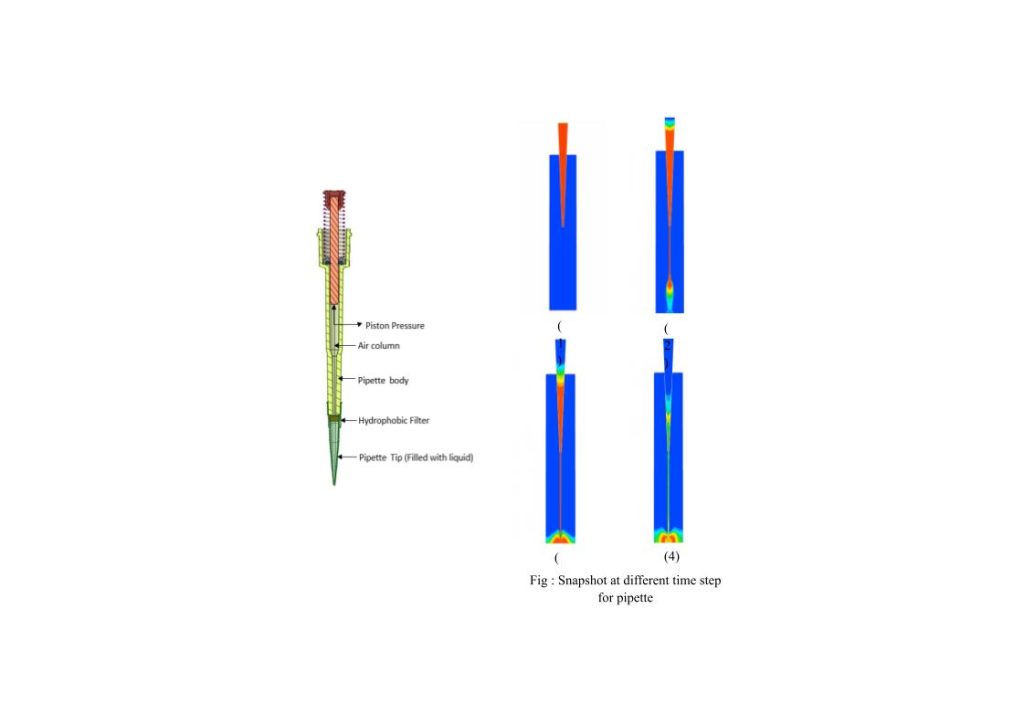
1. Simulating Liquid Handling in Medical Lab Equipment
A detailed CFD simulation was carried out on a handheld liquid-dispensing device an indispensable tool in clinical and research laboratories.
This project was driven by a single critical goal: ensuring exceptionally precise fluid measurement in every use.
The simulation focused on two main objectives:
- Accurately determining evacuation time: measuring how long it takes for the device to completely clear liquid.
- Pinpointing retention zones: identifying areas where even tiny traces of fluid might remain, risking sample purity or cross-contamination.
By visualizing internal flow paths, pressure gradients, and shear regions, engineers uncovered exactly how droplets behave inside the device.
These insights guided design refinements adjusting internal geometries and surface angles to achieve uncompromising accuracy in fluid measurement while improving hygiene and reliability.
Such precision is vital in applications like sample collection, DNA/RNA preparation, and pharmaceutical assays, where every microliter matters and every reading must be trusted.
2. Environmental Control for Cold-Chain Storage Facilities
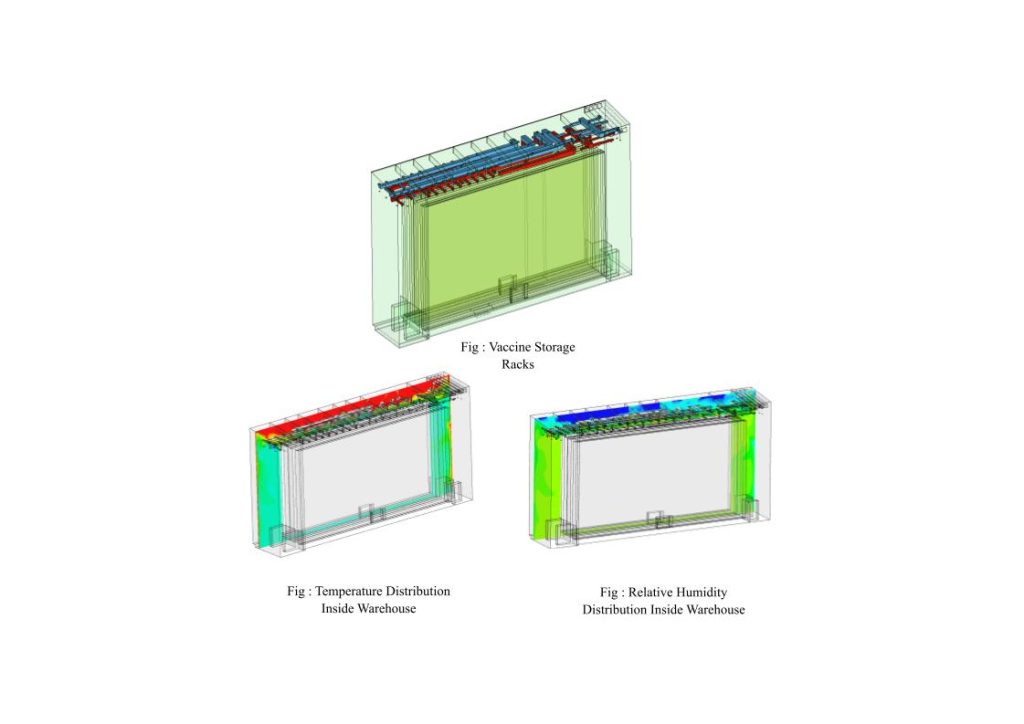
A thermal-fluid simulation was performed to evaluate and improve airflow and temperature distribution in a cold-storage warehouse used for vaccines and biologics.
The core purpose of this study was to maintain stable temperature and humidity levels critical for preserving temperature-sensitive inventory.
The simulation incorporated both thermal conduction through walls and convection currents generated by HVAC systems, delivering insights that included:
- Detailed temperature maps at various elevations and corners
- Relative humidity contours across storage aisles
- Identification of dead zones where air stagnation could compromise temperature-controlled storage
The analysis revealed that inefficient duct placement created localized hotspots and inconsistent humidity levels, particularly near storage racks and ceiling corners.
By virtually testing multiple HVAC configurations, engineers were able to optimize duct routing and fan placement ensuring uniform temperature and humidity control throughout the warehouse.
These improvements help maintain strict compliance with WHO and GMP guidelines for pharmaceutical logistics, guaranteeing that sensitive vaccines and biologics remain within their required environmental conditions.
3. Heating Performance in Temporary Medical Shelters
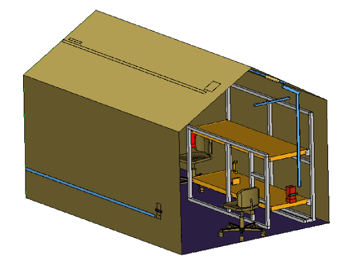
In extreme cold climates, achieving liveable temperatures inside temporary medical shelters can be life-saving especially for military field operations where rapid deployment and reliable performance are critical.
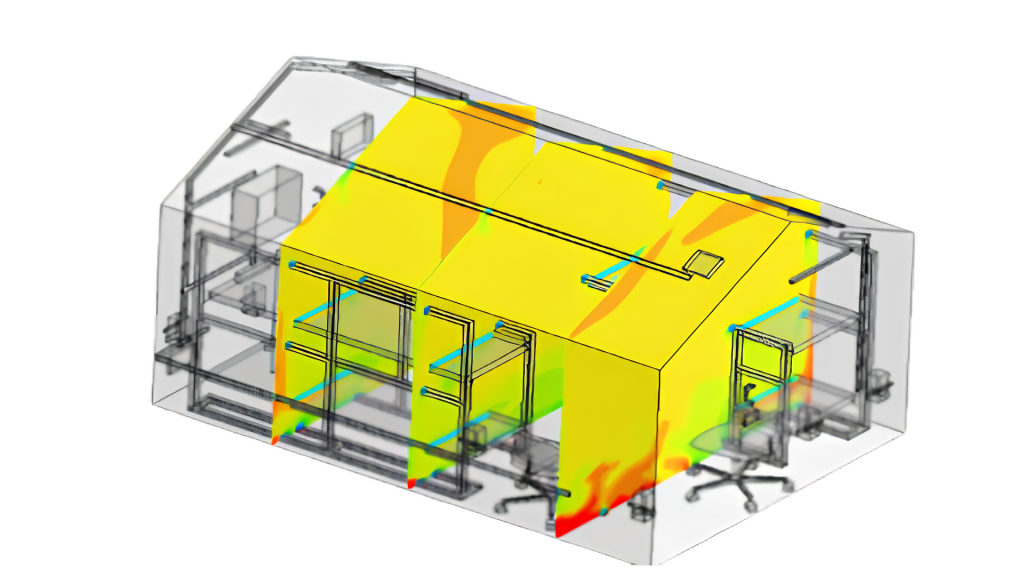
The purpose of this study was to simulate the heating and ventilation system to evaluate how effectively the shelter temperature could be raised from –40 °C to a comfortable 10 °C under real-world conditions.
A transient thermal simulation was carried out to test various heating configurations and insulation layouts. The analysis guided engineers in selecting optimal heater placement and insulation materials, ensuring rapid warm-up and energy-efficient operation in remote and challenging environments.
Key outcomes included:
- Predicted shelter heat-up time under realistic ambient conditions.
- Evaluation of insulation efficiency and heater positioning to achieve uniform comfort.
By virtually simulating these scenarios, the team refined the heating and ventilation design, ensuring that military medical shelters can quickly reach and maintain the target temperature, providing a safe and effective environment for critical medical operations in the field.
4. Ventilation Assessment in High-Temperature Facilities
Certain facilities, such as cremator rooms, operate in extremely high-heat environments where effective ventilation is critical for safety and operational reliability.
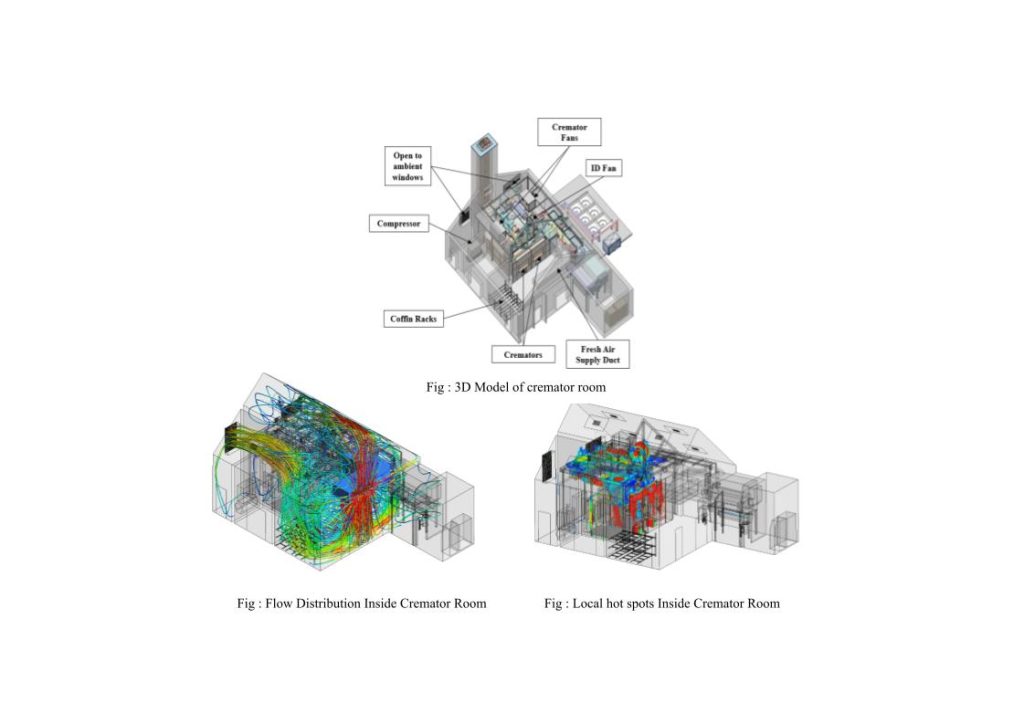
The purpose of this study was to simulate and analyse the ventilation system to control temperature and airflow, preventing overheating in and around the cremator area, especially in zones adjacent to sensitive medical or administrative spaces.
A detailed CFD simulation was carried out to map internal temperature distribution and identify ventilation inefficiencies. The findings helped engineers redesign exhaust placement and optimized airflow patterns to ensure stable, safe conditions.
Key outcomes included:
- Visualization of air circulation and hotspot formation across the cremator room.
- Optimized fan and exhaust placement to balance temperature zones and prevent heat buildup.
By implementing these improvements, facilities can enhance equipment longevity, protect staff health, and ensure uninterrupted, safe operation even during continuous or peak usage of the cremator room.
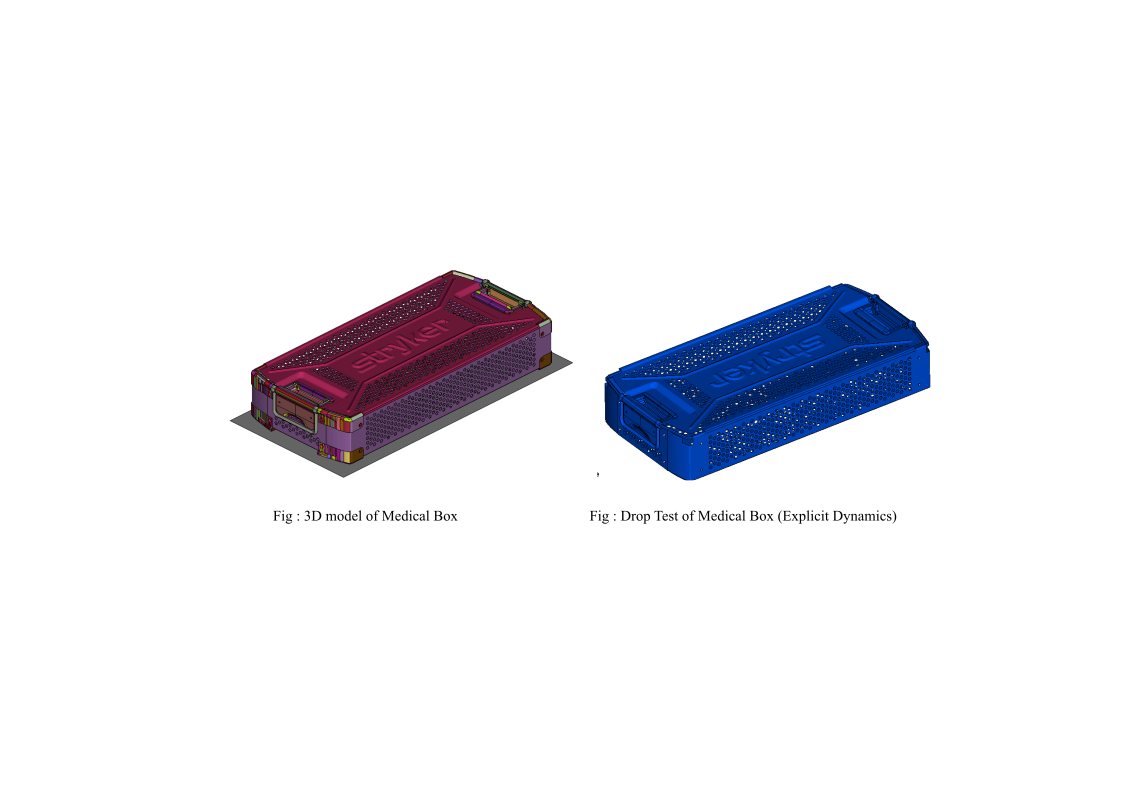
5. Structural Safety of Medical Transport Containers
Ensuring the safe transport of medical materials is critical. To validate the reliability of a newly designed protective container, a comprehensive drop-test simulation was conducted.
The objective was to evaluate and enhance the container’s ability to withstand real-world handling conditions while keeping its contents secure.
The simulation covered a range of impact scenarios, including edge and corner drops, replicating conditions commonly encountered during transit.
Findings from the analysis led to targeted design improvements such as reinforcing high-stress regions with optimized rib patterns and upgraded materials significantly improving structural integrity and durability.
Key outcomes:
- Simulated real-world drop scenarios to accurately assess stress distribution and deformation.
- Strengthened critical zones to enhance protective performance throughout transport.
By incorporating simulation early in the design process, the container was engineered to meet international handling standards. This provides hospitals, logistics providers, and field operations with the assurance that sensitive medical contents will remain intact, compliant, and uncompromised throughout their journey.
Challenges and Engineering Considerations
While CAE is powerful, success depends on:
- Mesh quality: Medical devices often involve complex geometries like mesh stents or anatomical curves that require high-fidelity meshing.
- Material modelling: Biological tissues and polymers used in medical devices demand advanced nonlinear material definitions.
- Validation: Simulation models must be validated against experimental or clinical data to gain regulatory and clinical trust.
Cross-domain knowledge: Engineers must collaborate with clinicians, biologists, and regulatory experts to ensure models are medically and mechanically accurate.
Why Choose Our CAE Expertise for Medical Applications
✔ Proven Experience in Critical Medical Applications
We have successfully supported projects across the medical sector, helping optimize device designs for safety, durability, and regulatory compliance.
✔ Advanced Simulation Capabilities
Our team uses FEA, CFD, and thermal/structural simulations to solve complex design challenges and predict real-world performance early.
✔ Faster Time-to-Market and Cost Savings
Virtual testing reduces design issues, shortens development cycles, and lowers material waste and overall costs.
✔ Deep Knowledge of Healthcare Needs
We understand strict safety standards and help bridge the gap from concept to regulatory-ready products.
✔ Collaborative and Data-Driven
We work closely with your teams and provide clear simulation evidence that supports approvals and builds confidence in your final product.