
Defence Engineering Services: The Role of Simulation Analysis

Engineering Insights: Simulation & Design in the Oil and Gas Industry
June 12, 2025
How Advanced Computer Aided Engineering (CAE) from Engineering Services Companies Is Revolutionizing Medical Innovation
July 31, 2025
Introduction
Why Smarter Design Matters in Defence
Modern defence systems face extreme conditions heat, impact, pressure, and unpredictable terrain. Whether it’s an armoured vehicle, a drone, or a missile launcher, each component must be safe, reliable, and efficient.Modern defence systems face extreme conditions heat, impact, pressure, and unpredictable terrain. Whether it’s an armoured vehicle, a drone, or a missile launcher, each component must be safe, reliable, and efficient.
Simulation answers critical questions early:
Will this structure survive a blast?
Will the drone overheat mid-flight?
Can we reduce drag without sacrificing stability?
The result? Safer systems, faster development, and better decisions.
How Simulation Supports the Defence Sector
CAE tools help defence engineers recreate real-world conditions using digital models. This leads to faster designs and more reliable outcomes. Here are the core areas where simulation makes an impact:
Key Capabilities in Defence-Focused CAE
Structural Analysis (FEA)
Simulate how structures behave under load, vibration, or blast. Ideal for:
- Armoured vehicles
- Support frames
- Weapon mounts
- Suspension systems
Fluid and Thermal Analysis (CFD)
Model air and fluid movement, pressure zones, and heat flow. Useful for:
- UAV and missile aerodynamics
- Cooling systems in electronics
- Naval hull resistance
- Thermal shielding
Combined Physics (Multiphysics)
Some systems deal with heat, pressure, and vibration at once. Multiphysics tools let you simulate these combined effects.
- Heat-affected electronics
- Missile component stress
- Drones under aerodynamic and thermal load
CAD and Prototyping Support
Convert ideas into 3D models, run simulations, and adjust designs quickly. This leads to faster prototyping and fewer design mistakes.
Acoustic and Vibration Analysis
Simulate how sound and vibration travel through structures. Helps reduce noise, improve stealth, and protect sensitive electronics.
Where These Capabilities Are Used in Defence
Simulation is valuable in many defence engineering areas:
- Ground Vehicles: Structural testing for impact, rollover, and terrain loads
- Aerospace & Drones: Drag reduction, lift optimisation, and heat control
- Naval Platforms: Hull flow, cavitation, and vibration in harsh seas
- Defence Electronics: Heat dissipation, shock resistance, and case integrity
- Weapons Systems: Stress from recoil, rapid firing, and long-term fatigue
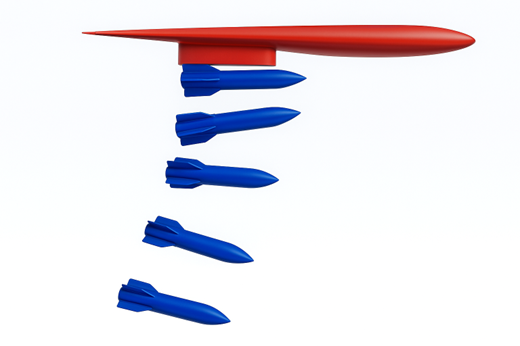
Missile 6 Degrees of Freedom (6 DOF) analysis
6 Degrees of Freedom (6 DOF) analysis models a missile’s complete motion in 3D space. It includes translation along the X, Y, and Z axes, as well as rotation pitch, yaw, and roll. This simulation helps capture how aerodynamics, propulsion, and control systems interact during flight.Engineers use 6 DOF analysis to evaluate missile stability, trajectory accuracy, and control response. It plays a key role in validating guidance systems under various flight conditions. By simulating the missile’s full dynamic behaviour before launch, teams can optimise performance, enhance reliability, and ensure the system meets mission requirements.
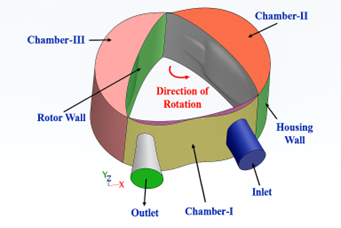
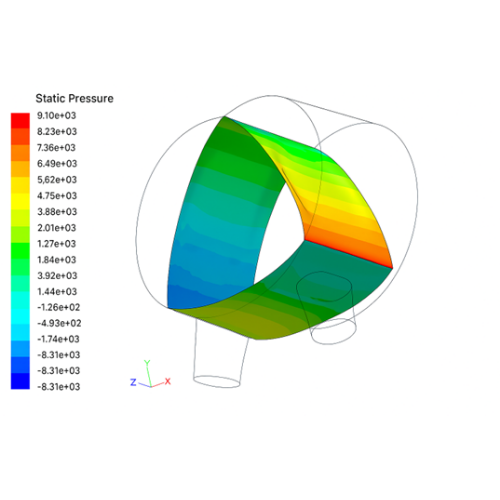
Wankel Engine CFD and Structural Simulation
We conducted a detailed CFD and structural analysis of a Wankel rotary engine to evaluate internal flow behaviour and pressure distribution. The model included defined chambers, inlet and outlet ports, and rotor motion. Time-dependent simulations captured how static pressure changed during the engine cycle, offering valuable insight into combustion chamber efficiency and flow balance.A refined mesh was generated for both the rotor and housing to ensure accuracy. The analysis identified critical pressure zones and stress paths, helping us optimise the chamber geometry. These results contribute to improving thermal performance, structural durability, and overall engine efficiency.
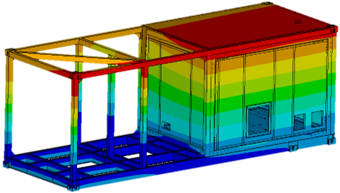
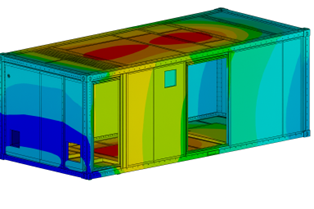
Structural Analysis of Military Shelters Using FEA
We performed finite element analysis (FEA) on modular military shelters to assess their structural behaviour under static and operational loading. The simulations revealed how stress distributes across the frame and where deformations are likely to occur. Areas around the roof panels and support joints showed higher stress, guiding key design improvements.This analysis ensures the shelters are capable of withstanding harsh environmental conditions, transport loads, and repeated field deployment. The results support better durability, reduced material fatigue, and improved overall structural integrity making these shelters more reliable and mission-ready in real-world defence operations.
\
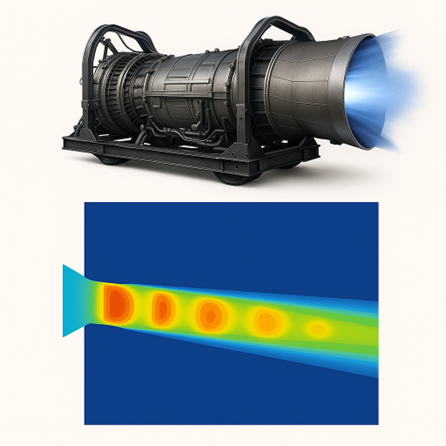
CFD Analysis of a Supersonic Nozzle
Supersonic nozzles are critical components in high-speed propulsion systems, used to accelerate flow beyond the speed of sound. Their geometry is specifically designed to control pressure, temperature, and Mach number through the convergent-divergent (C-D) profile. Understanding how shock waves, expansion fans, and boundary layers interact within the nozzle is essential to ensuring efficient performance.Supersonic nozzles are critical components in high-speed propulsion systems, used to accelerate flow beyond the speed of sound. Their geometry is specifically designed to control pressure, temperature, and Mach number through the convergent-divergent (C-D) profile. Understanding how shock waves, expansion fans, and boundary layers interact within the nozzle is essential to ensuring efficient performance.
We carried out a CFD analysis to study flow characteristics across various operating conditions. The simulation helped visualise Mach contours, pressure gradients, and potential shock interactions within the nozzle throat and exit region. These insights support design validation and performance optimisation in aerospace applications.
Gas Turbine Combustors: The Heart of Power Generation
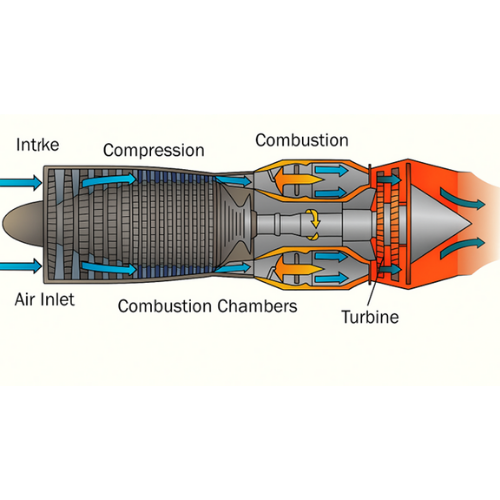
A gas turbine combustor is the part of the engine where fuel is mixed with compressed air and ignited to produce high-energy gases. These hot gases then flow through the turbine stages, helping generate thrust or mechanical power. The design of the combustor plays a key role in determining the engine’s performance, efficiency, and emissions. By studying airflow, temperature, and combustion behaviour inside the chamber, engineers can improve the design for better fuel use and reliability. This helps make gas turbines more efficient and suitable for both aviation and industrial power generation.
Thrust Vectoring: Combining CFD and FEA for Precision Control
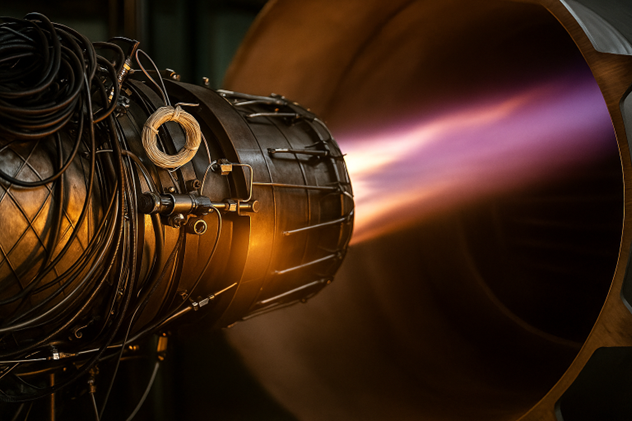
Thrust vectoring technology allows aircraft and missiles to control their direction by redirecting engine exhaust, improving manoeuvrability beyond what control surfaces alone can achieve. Accurate modelling of flow deflection and thermal behaviour is essential, especially at high speeds and varying flight conditions. CFD simulations help analyse shock patterns, jet interactions, and nozzle flow characteristics during vectoring manoeuvres.
To ensure mechanical reliability, FEA is used alongside CFD to evaluate structural stresses, thermal expansion, and fatigue in nozzle components. This combined approach helps engineers optimise both performance and durability, supporting the development of advanced propulsion systems for modern aerospace applications.
What Makes a Great CAE Partner for Defence Projects
Organisations that provide defence-focused CAE support typically offer:
- Fast and scalable project delivery
- Simulation across multiple disciplines
- Security practices suited for sensitive work
- Experienced engineers with domain knowledge
- Support for R&D, prototyping, or full product cycles
They can work as an extension of your team or lead entire simulation-driven design projects—from scratch to solution.
Conclusion: Design Smarter. Simulate First.
Modern defence engineering can’t afford guesswork. Systems must work the first time, every time. Simulation helps teams design with confidence—testing ideas virtually, finding problems early, and delivering stronger results.With the right CAE support, you can reduce costs, shorten development cycles, and create systems that meet mission goals with precision.
Why Choose Analyzer CAE Solutions Pvt. Ltd.
At Analyzer CAE Solutions, we understand the critical demands of the defence sector—where performance, reliability, and safety are non-negotiable. With over 17 years of experience supporting mission-critical projects, we offer specialised simulation-driven engineering solutions tailored for defence applications.
Why defence clients choose us:
- Deep Expertise in Structural & Thermal Analysis of military platforms, shelters, UAVs, and weapon systems
- Advanced Multiphysics Simulation for blast loading, heat dissipation, fatigue, and shock response
- End-to-End Support from concept design to digital validation, including CAD, FEA, and CFD
- Domain-Specific Experience in vehicle armour, missile systems, thermal shielding, and electronic enclosures
- Confidentiality and Security Protocols aligned with sensitive defence work
- Quick Turnaround with High Accuracy, ensuring readiness for field conditions
- Proven Track Record supporting DRDO projects, defence contractors, and R&D institutions